This stretch of coast supports an important group of rare moths and butterflies. The locations mentioned below refer to Britain only. Devon Species of Conservation Concern include:
- Gold-edged Dot (Stigmella auromarginella). Only found along the coasts of Dorset and east Devon. Caterpillars feed by mining the leaves of brambles.
- Dingy White Plume (Merrifieldia baliodactylus). Caterpillars feed on Wild Marjoram in spring, biting through the stem and causing the upper leaves to wilt.
- Colt’s-foot Miner (Scrobipalpula tussilaginis). Also found on the Dorset coast and one site in Hampshire. Caterpillars feed by mining the leaves of Colt’s-foot, often turning these purplish. The mines are conspicuous so easily recorded.
- Goat Moth (Cossus cossus). Caterpillars feed on living wood, living inside the trunks or branches of various species of tree. On the east Devon coast they have been found in Grey Willow. This stretch of coast is probably a refuge to where this previously more widespread species has retreated.
- Mere Wainscot (Photedes fluxa). Feeds on Wood Small-reed and in Devon is now mainly found along this stretch of coast and near Croyde on the north coast.
- Wight Pea Moth (Grapholita gemmiferana): Similar distribution and foodplant to the Everlasting-pea Blister Moth. See below.
- Dingy Skipper (Erynnis tages). Caterpillars feed on Common Bird’s-foot-trefoil.
- Small Blue (Cupido minimus). Caterpillars feed on Kidney Vetch. Very locally situated in Devon, main sites are East Devon coast, Torbay coast and Braunton Burrows. East Devon sites tend to be managed naturally by occasional cliff fall and erosion creating the required breeding conditions.
- Adonis Blue (Polyommatus bellargus). Caterpillars feed on Horseshoe Vetch.
Six species in this group are listed as Devon Special Species in their own right:
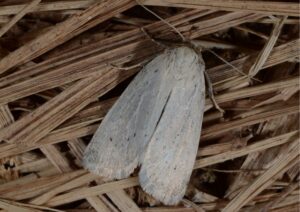
Morris’s Wainscot (moth)
Photedes morrisiiIn the UK, Morris’s Wainscot is only found on this stretch of coast, between Axmouth and Eype in Dorset. It lives at the base of slipping cliffs, where the caterpillar’s foodplant Tall Fescue grows. Larvae are found in the stems of smaller, weak plants which are stressed by growing on the slipping cliff.
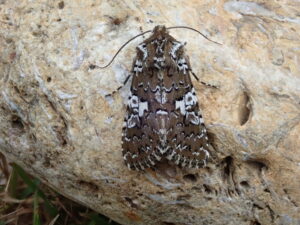
White Spot (moth)
Hadena albimaculaWhite Spot caterpillars feed on the seeds of Nottingham Catchfly, which is also a Devon Special Species. They initially live in the seed capsule, then hide under the base of the plant by day and feed on the seeds at night.
The moths fly in May and June. White Spots are found on vegetated shingle and chalk or limestone cliffs from Branscombe to Kent where Nottingham Catchfly grows. In Devon, they’re found between Branscombe and Axmouth.
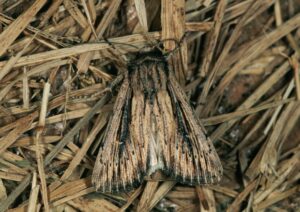
Devonshire Wainscot (moth)
Leucania putrescensThe Devonshire Wainscot is only found on the coasts of Devon, Cornwall, Somerset, south Wales and Pembrokeshire. It’s rare in Devon but can be seen along both the north and south coasts.
Adults fly from mid-July to early September. Eggs are laid on various grasses which caterpillars feed on through the winter.
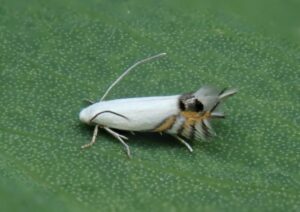
Everlasting-pea Blister Moth
Leucoptera lathyrifoliellaThis micromoth is only found on the coast between Shaldon and Branscombe and a few other locations including the Isle of Wight and one in Wales. Caterpillars feed on the Narrow-leaved Everlasting-pea, but also can also occur on Meadow Vetchling and Broad-leaved Everlasting-pea when near Narrow-leaved Everlasting-pea. The Wight Pea Moth (Grapholita gemmiferana) has a very similar distribution and now does not occur further west than Salcombe Mouth, near Sidmouth. It has the same main foodplant.
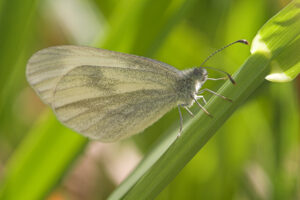
Wood White (butterfly)
Leptidea sinapisThe Wood White is one of the UK’s lightest and smallest butterfly species. It has a unique, almost ghostly appearance due to its pale, white wings.
It lives in habitats with tall grassland or light shrub (which provide shade and shelter) and with vetches (the caterpillar foodplant), including Bitter Vetch, Tufted Vetch, Common Bird’s-foot-trefoil and Greater Bird’s-foot-trefoil.
It breeds twice a year with adults flying in May or June and August. In Devon, the remaining populations are found on this stretch of coast (due to the scrubby grasslands), Meeth quarry in north Devon and Cookworthy Forest.