
Skip to content

Ancient trees, veteran trees and deadwood

Some ancient oak trees in Devon are thought to be around 1,000 years old.

The dead and decaying wood in and from these trees is one of the most wildlife-rich and important habitats in Devon.

Other important microhabitats in veteran trees include rot holes, loose bark and sap runs.

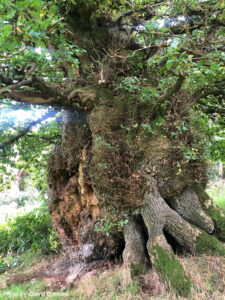
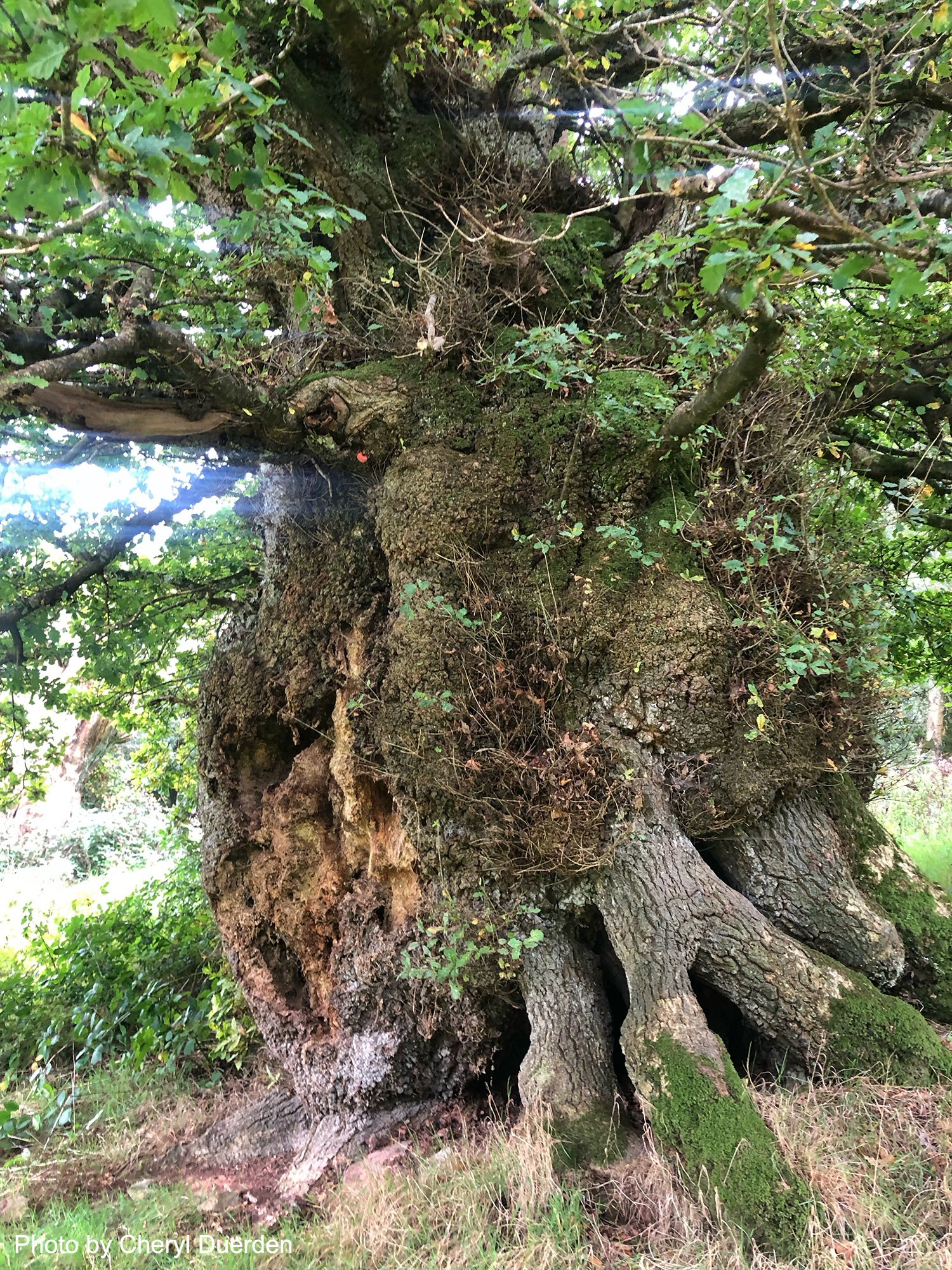
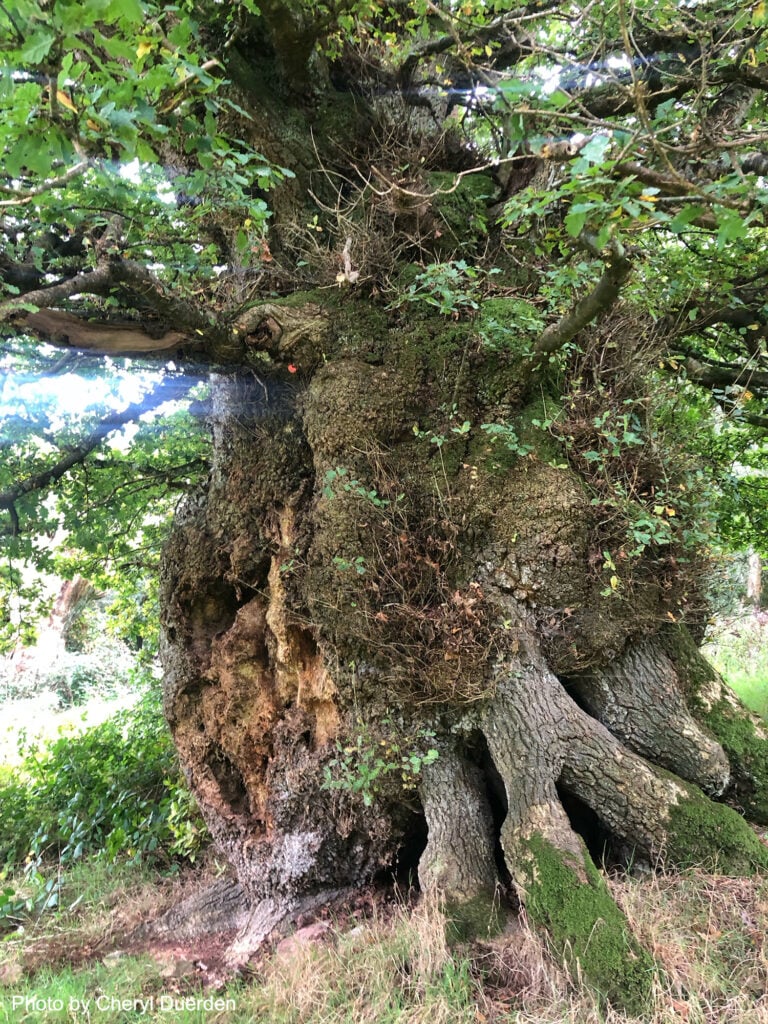
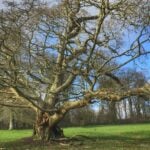
Ancient tree at Killerton, a warped twisted trunk with lots of small plants taking over

Killerton, Cheryl Duerden

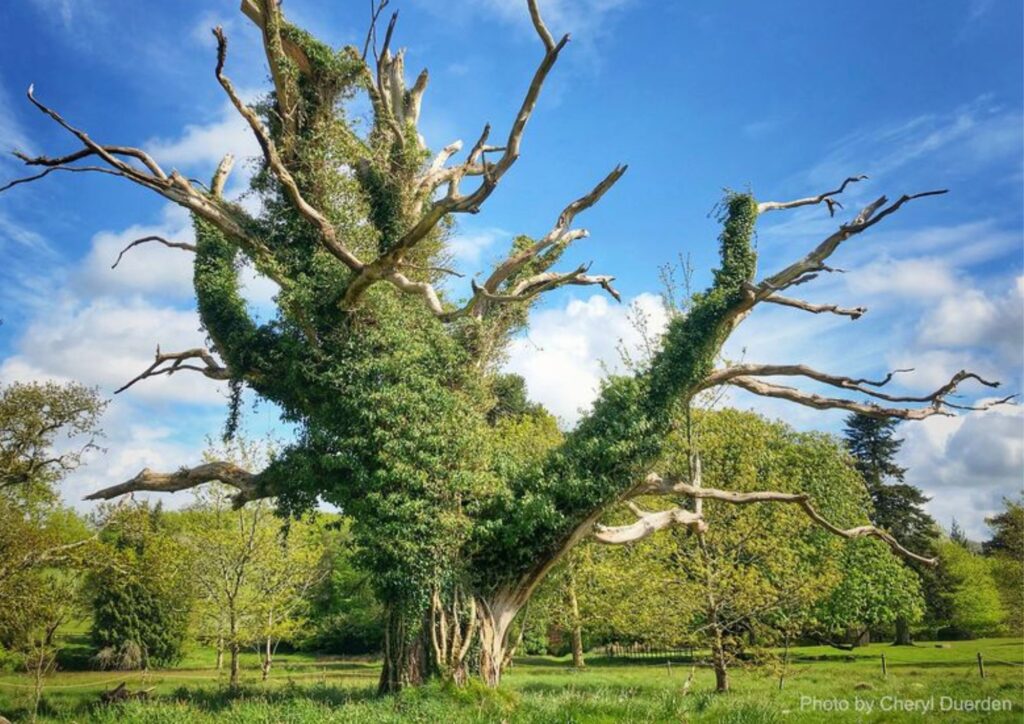
Large old ancient tree within parkland, overgrown with ivy and other green leaves, with no new growths from the branches

Arlington Court, Cheryl Duerden

Snapshot

What wildlife-rich looks like:

Dead branches, decaying wood, holes, cavities, splits, sap runs and loose bark. Ancient trees with wide and hollow trunks. Features support a wealth of wildlife, particularly moths, beetles, flies, fungi, lichens, nesting birds and roosting bats. A range of flowering plants, trees and shrubs are close by and provide nectar and pollen for the moths, beetles and flies.
Devon Special Species include:

Birds: Hole nesting species: Lesser Spotted Woodpecker, Pied Flycatcher, Spotted Flycatcher, Marsh Tit, Kestrel, Starling (but all insect eaters will benefit)

Bats: Bechstein’s, Barbastelle (but all will benefit from the insects)

Insects: Moths of Dartmoor broadleaved woodlands, Blue Ground Beetle, Six-spotted Longhorn Beetle, Apple Lacebug, veteran tree flies

Lichens and fungi: Deadwood fungi and lichens, veteran tree lichens.

UK significance:

UK priority habitat: Yes

Statutory irreplaceable habitats: Ancient and veteran trees

Wider benefits: Carbon storage, pollinators and natural pest control (insects)

1. About

Ancient and veteran trees are exceptionally rich in wildlife.

Ancient trees are those which have reached a great age for their species. An ancient oak tree might be around 900 years old, while an ancient hawthorn has a shorter lifespan and be only 150. They often have very wide trunks (some large trees can look squat) and many are hollow. Due to their age they support features such as dead and decaying wood, fungi, splits, holes, cavities, sap runs and loose or flaking bark.

Veteran trees share many of the features of ancient trees but can be any age, so all ancient trees are also veteran trees but many veteran trees aren’t ancient. Some veteran trees can be relatively young but have developed ancient features due to environmental stress or as a response to physical damage.

Since all ancient trees can also be defined as veteran trees, on this page the term veteran tree is used for both.

Veteran trees are found across Devon, in woodlands and as individual trees in rural and urban settings such as parks, churchyards and cemeteries. Concentrations can be found in wood pasture and parkland habitats. The Woodland Trust’s ancient tree map shows that the majority are in the southern half of Devon, particularly in east Devon and south-west of Dartmoor.

Famous ancient trees in Devon include the King John’s Oak, an 800-year-old oak tree in the medieval deer park at Shute in east Devon and the Meavy (Royal) Oak on Dartmoor, which is thought to be 900 years old.  

The features found in veteran trees provide microhabitats for a wealth of wildlife including invertebrates, lichens, fungi, mosses, bats and birds.

A few key features, and the wildlife they support, are:

Holes and crevices: Holes provide shelter and nesting sites for a range of species. Many birds nest in holes, including woodpeckers, Tawny Owls, Barn Owls and Nuthatches. Devon Special Species include Lesser Spotted Woodpeckers, Pied Flycatchers and Spotted Flycatchers. Most species of bat (other than Horseshoes) will roost in tree holes and tiny crevices, including rare Bechstein’s Bats. Bats also use trees for maternity roosts in the summer. Ancient trees with wide trunks, where temperatures remain more stable, provide hibernating sites for bats.

Dead and decaying wood: Dead and decaying wood is one of the most wildlife-rich and important microhabitats in Devon. A group of invertebrates (known as saproxylic invertebrates) depend on dead or decaying wood and associated fungi. They are good indicators of a healthy ecosystem as they facilitate decomposition and nutrient recycling. Individual saproxylic species require different types of decaying wood (such as red rot and white rot) and this rot can vary depending on the position of decay on a given tree and also between tree species. . 

Larvae of rare beetles (such as the Six-Spotted Longhorn Beetle now only found at Watersmeet SSSI) feed on the dry rot typical of the heartwood in old trees. Rare fly larvae prefer to feed on moist, white rot, typical of sap wood and younger veteran trees. A group of rare lichens live on well-lit, dry and exposed deadwood.

Veteran trees in Dartmoor’s woodlands support rare invertebrates. These include the endangered Blue Ground Beetle, which hibernates under bark or in dead wood, and rare moths such as the Silver-streaked Beauty and Beautiful Bark Moth, which feed on decaying wood found under bark.

Some of the UK’s largest and most attractive flies are associated with decaying wood. In Devon these include the Buff-tailed Bumblefly (a hoverfly) and the Orange-belted Plumehorn and the spectacular Orange-sided Comb-horn (both craneflies). 

Bark: Rare lichens live on well-lit, old bark found on veteran trees, while rare Barbastelle Bats roost under flaky bark. Bark also provides shelter for invertebrates.

Fungi: Many invertebrates, particularly flies, feed on decomposing fungi found on veteran trees, such as bracket fungi. In Devon a number of these bracket fungi such as Oak polypore and Fuscoporia wahlbergii are very rare nationally and occur at less than a handful of sites in Britain.

Veteran trees are important habitats in orchards. For example, the threatened Apple Lacebug is only known from old apple trees in Devon and Cornwall.

Numbers

Ancient and veteran trees are recorded on the Ancient Tree Inventory, which is managed by the Woodland Trust and based on volunteer assessment and recording. It’s not a statutory record and some estimate that only 10% of ancient and veteran trees are included. Trees recorded in Devon since 2004:

  • Ancient trees: 131 
  • Veteran trees: 1,168 
  • Notable trees: 777 

Designations and protection

Veteran trees are in the wood pasture and parkland SSSIs as contributory features, although none are designated individually. Many will be subject to Tree Preservation Orders but there is no central record. It’s thought that 75% are not subject to formal protection.

Condition

There is evidence that in the last century, 50% of veteran trees have been lost in parts of England.

There are no specific records of the overall condition of ancient and veteran trees in Devon.

Between 2010 and 2015, deadwood levels were unfavourable in 80% of native woodland habitat and 73% of non-native woodland habitat. This is the single biggest reason for woods being in unfavourable condition (National Forest Inventory 2020).

Key pressures and opportunities

Much of the nature value of veteran trees, in particular for fungi and invertebrates, lies in their deadwood (large or small diameter, still attached to the tree or lying on adjacent ground). Concerns over safety and ‘untidiness’ often lead to deadwood being removed and crowns reduced, usually when this is unnecessary.

Lack of management in the areas surrounding  veteran trees can also reduce their lifespan. For example, veteran trees can be stressed by competition for water and nutrients if scrub is allowed to develop between the edge of the canopy and the trunk.

Veteran trees continue to be felled unnecessarily because they’re believed to be dying when bracket fungi are found growing on them. Across our urban and rural landscapes, brash is burnt in bonfires or chipped rather than being left or piled in a corner where it can rot down naturally.   

Veteran trees in woodlands (especially conifer plantations on ancient woodland sites) can be overlooked and overshaded by other trees.

Robust root systems with  associated mycorrhizal fungi are essential for the health of veteran trees by enabling the efficient uptake of nutrients and water. Ploughing and compaction, whether by animals and vehicles or even poorly sited mountain bike trails, can directly cause damage to the roots and the surrounding soils.,  This in turn can disrupt the flow of nutrients available and lead to the premature loss of tree limbs or death of the tree. Building developments and works to install underground services have a similar effect – sufficient spacing between new builds and veteran trees should be encouraged as retaining or reinstating permeable rooting areas is critical.

Veteran trees are being lost due to diseases such as acute oak decline, sudden oak death, Dutch elm disease and ash dieback. However, there is a silver lining to the impact of these diseases, though only temporary, and that is an increase in standing and fallen deadwood present across the county..

The loss of any veteran tree can be catastrophic for the species that it hosts especially if  no other veteran trees are present in the surrounding area.. Many species that rely on veteran trees (especially invertebrates and lichens) are only able to disperse over short distances and now often live in isolated refuges. It’s critical that replacement trees are allowed to grow and mature and that networks of future veteran trees are created in order that species can move across a given landscape.      

Ancient trees have a relatively high level of resilience compared to younger trees of the same species. However, there’s a risk that trees growing in the open may be more susceptible to waterlogging,, drought or storm damage, especially if they’re already compromised by inappropriate habitat management or proximity to developments.

Ancient and veteran trees have huge cultural and historic value. They’re much loved, which provides great opportunities to increase awareness and action for existing trees and ensure that a network of future veteran trees is developed.

There is funding available from the Forestry Commission to support the management of veteran trees.

2. What we need to do and where

Priority

Better (healthy and wildlife-rich) and more ancient and veteran trees, benefiting Devon Special Species and achieving wider benefits such as carbon capture.

See Find out more below for relevant national and local targets.

Actions for ancient and veteran trees

See Find out more below for links to detailed guidance and sources of funding and advice.

Manage ancient and veteran trees and their microhabitats (decaying wood, holes, loose bark) for wildlife. Get expert advice from veteran tree specialists and develop management plans for individual trees and key populations.

  • Leave standing and fallen deadwood, collapsed trees and branches (even small ones), other than where there’s a clear safety issue and no alternatives. Pile up deadwood and fallen branches rather than chipping or burning them. Wood should not be stacked against tree trunks.
  • Protect the root zone through sensitive management (consider impacts from vehicles and bikes, ploughing and stocking rates) and during infrastructure projects. Consider brash piling (especially fallen deadwood) and bramble zones to prevent compaction and increase habitat but without shading the trunks. 
  • Carry out works at times that are least likely to affect wildlife. For example, take care during breeding and hibernation seasons.
  • Avoid carrying out works in woodlands that will cause sudden changes in light levels or humidity as these can reduce the wildlife value of veteran trees, including by affecting bat roosts.
  • Carry out sensitive thinning of woodlands around existing veteran trees to give them more space and exposure to light.

Create networks of future veteran trees across Devon so that species have continuity of habitat and can disperse across the county

  • Plant trees, allow natural regeneration and, where needed, carry out veteranisation of younger trees near to existing veteran trees. Follow national best practice guidance and standards regarding, for example, species selection and spacing.
  • Veteranise younger trees in even-aged woodland and broadleaved monoculture plantations. 

Develop and implement collaborative landscape-scale approaches to squirrel control and deer management.

Survey, research and awareness

  • Increase training for volunteers to carry out surveys, including specialist surveys for species such as invertebrates, bats and lichens.
  • Everyone to share records to improve the Woodland Trust’s Ancient Tree Inventory to better understand Devon’s trees, target action and monitor change.
  • Train more specialist veteran tree consultants.
  • Develop a joined-up network and advice service (rural and urban) for land managers that:
    • Raises awareness of the value of veteran trees, their microhabitats and species.
    • Raises awareness of dead and decaying wood.
    • Promotes management best practice and funding streams.
    • Increases understanding of bracket fungi and when they do or do not pose a risk to trees and safety.
    • Promotes engaging flagship species such as the Buff-tailed Bumblefly.
    • Promotes demonstration sites and case studies.
  • Support and build on the work of the Devon Ancient Tree Forum.

Where to focus action

Wildlife will benefit from these actions being implemented across Devon and no High Opportunity Areas have been mapped specifically for Ancient and Veteran trees.

The Woodland Trust’s map of records of Ancient and Veteran trees is shown on the LNRS Viewer under Designated Sites and Statutory Irreplaceable habitats. This mapping is not comprehensive and in line with government policy (Keepers of Time, 2022) all ancient and veteran trees (including their root zones) should be considered as statutory irreplaceable habitats. Please contact the Woodland Trust to add trees to the map.

Actions are relevant in the following High Opportunity Areas. See Mapping.

  • Ancient and other broadleaved woodland (existing)
  • Plantations on ancient woodland sites (existing)
  • Ancient wood pasture and other wood pasture and parkland sites (existing)
  • Woody habitat expansion areas (Warning: this layer includes scattered small areas which are not continuous with woodlands. These will be removed after the public consultation when the map is reviewed)   

Advice should be obtained before any tree establishment, including natural colonisation, takes place in the following High Opportunity Areas and Species Opportunity Areas to ensure that it complements and supports existing wildlife:

  • All areas in the Wildlife-rich grassland mosaic group
  • All areas in the Heath, mire and rush pasture mosaics group
  • All areas in the Upland bog, heath and mire mosaics group
  • Coastal habitats and Coastal Wildbelt
  • Dartmoor breeding wader recovery zones
  • Whinchat zones
  • Wintering estuarine birds
  • Teign Gorge rock spiders
  • Greater Horseshoe and Grey Long-eared Bat sustenance zones
  • Marsh Fritillary and the Narrow-bordered Bee Hawk-moth zone
  • South Devon arable plant zone

Important:

Always check that actions will not conflict with statutory requirements (for example, statutory wildlife sites such as SSSIs or scheduled monuments) or harm existing wildlife habitats, the historic environment or landscapes. See the Environmental considerations page for more information.

3. Inspiration

Case studies

Devon Ancient Tree Forum

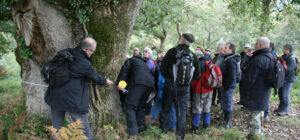
The Devon Ancient Tree Forum brings together specialists, enthusiasts and ancient tree owners to share best practice and visit sites across Devon

People gathered around an ancient tree, measuring the circumference.

Phear Park, Exmouth

Located in the heart of Exmouth, Phear Park is a rich mosaic of habitats, including mature oak trees, wildflower meadows, and managed grasslands that foster a thriving ecosystem. As part of the Wild Exmouth project, initiatives like the Tree Trail and Wildflower Wardens have highlighted the park’s ecological value, with volunteers documenting native flora and promoting sustainable land management. The park’s diverse tree population – featuring several varieties of oak (some nearly 400 years old!) – provides shelter and food for birds, insects and small mammals. These efforts demonstrate how thoughtful stewardship of public green spaces can enhance urban wildlife corridors and deepen public appreciation for nature.

Ideas: The Flitton Oak, North Molton, nominated for Tree of the Year in 2023. Halo thinning carried out for overshading beech. National Trust.

Where to visit

Always follow the Countryside Code and keep to footpaths and sites that are managed for public access. 

Parklands and churchyards

Ancient and veteran trees can be seen in National Trust parklands at Killerton, Saltram, Arlington and Knightshayes and urban parks such as Devonport in Plymouth and Phear Park in Exmouth.

Kenn and Farway churchyards both have a yew tree exceeding a thousand years old, these pre-date the building of the churches.

Ancient tree at Killerton, a warped twisted trunk with lots of small plants taking over

For information on visiting some of these and other sites that are open to the public please see the Explore Devon website.

4. Find out more

An inventory of Devon’s wood pastures and veteran trees was produced in 2007.

The Devon Tree and Woodland Strategy (2024) can be found on the Devon Local Nature Partnership website

The Ancient Tree Forum has lots of useful resources and the The Devon Ancient Tree Forum provides a network for anyone interested in ancient and veteran trees.

Mapped ancient and veteran trees in Devon are shown on the Woodland Trust’s Ancient Tree Inventory (the inventory as of 2025 is shown on the LNRS Viewer). Please add trees to this map (all additions are visited and verified by a Woodland Trust expert).

The Woodland Trust and Ancient Tree Forum have produced guidance on caring for ancient and veteran trees on farms  and Ancient and Veteran trees: further guidance on management

Veteran Trees – A guide to good management, English Nature

The British Association for Shooting and Conservation (BASC) has produced guidance on dead wood.

FUNDING: There is funding through Government agri-environment schemes for management of veteran trees and wood pasture and parkland. 

The key Government policy position is set out in Keepers of Time.  This states that all ancient woodland and ancient and veteran trees are irreplaceable, regardless of whether they are present on the Ancient Woodland Inventory or Ancient Tree Inventory.  

VetCert qualifications for veteran tree management professionals  are now available across Europe, in the UK via the Arboricultural Association.

Prediction of distribution of veteran trees in the UK (published 2021) – This used modelling and the data in the ATI to learn more about the likely distribution of ancient and veteran trees across the UK  and produce a distribution map that highlights ‘hotspots’  likely to support unrecorded ancient trees.  Based on this, the most conservative estimate of ancient tree abundance in English wood-pastures was 101,402 trees, representing an increase of more than 2,000 %  on the known number of ancient trees in wood pastures. This prediction suggests that most ancient trees in the English landscape are yet to be recorded.  Full paper here.

Land managers – especially of wood pasture and parkland sites.

National Trust

Woodland Trust

Devon Ancient Tree Forum

Devon Tree Officers

Protected Landscapes

Arboricultural Association

Natural England (SSSIs, ELM)

  • Ancient tree forum image, Ancient Tree Forum
  • Ancient tree at Killerton, Cheryl Duerden

Draft