
Skip to content

Reptiles and amphibians

Many of Devon’s reptiles and amphibians can be found in parks and gardens.

Smooth Snakes and Sand Lizards have been re-introduced to Devon’s heaths and dunes. 

Common Lizards and Slow Worms can lose their tail when attacked to distract predators.

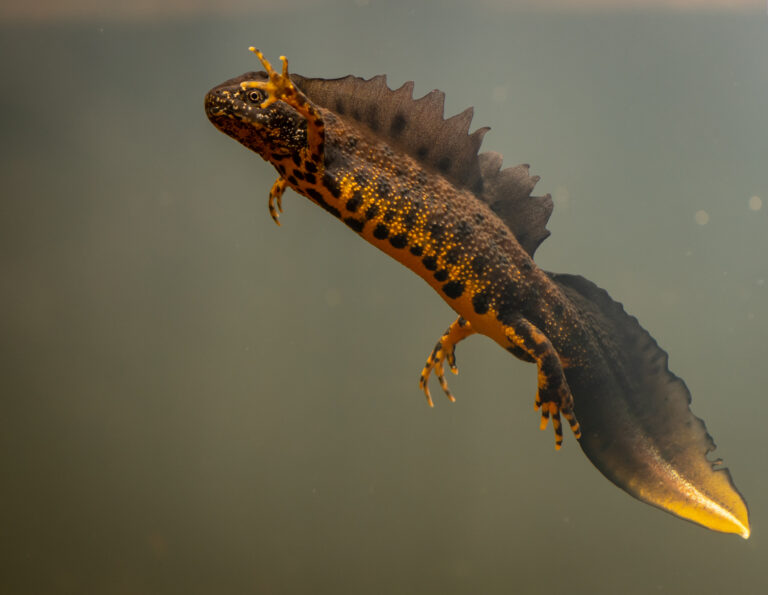
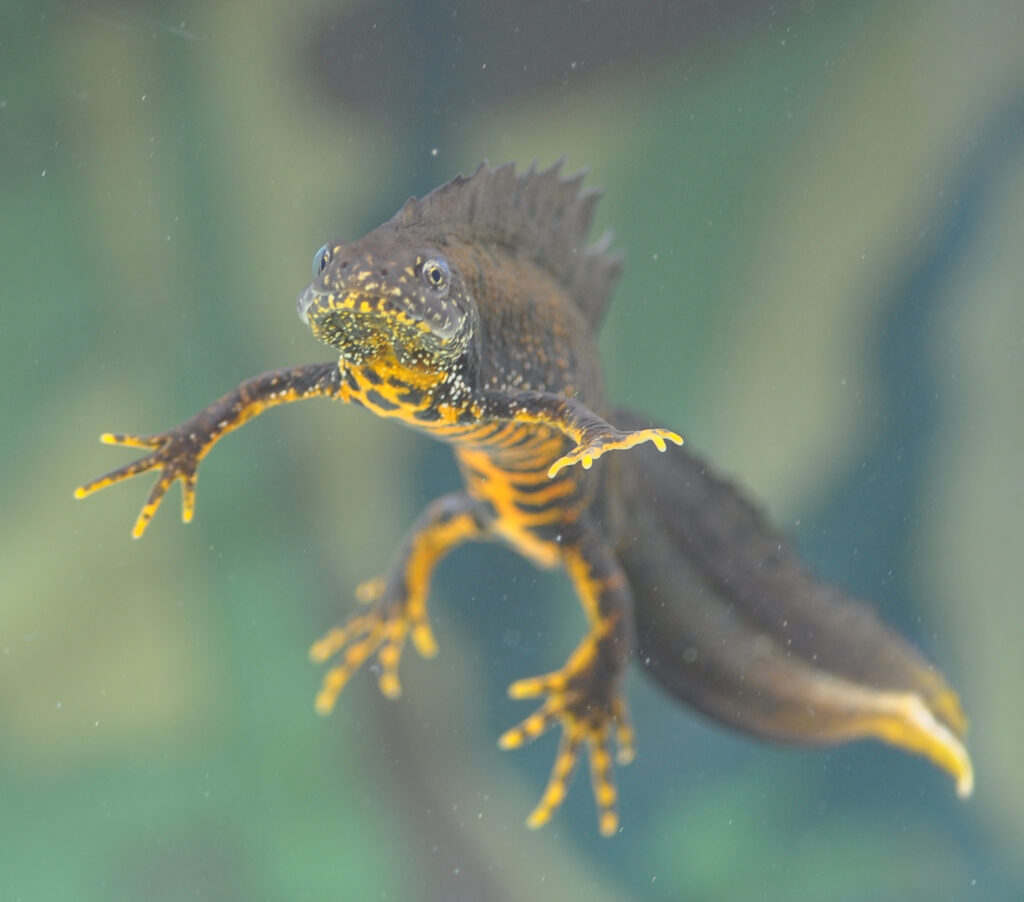
A great crested next hangs suspended in blurred blue-green water, The next has a bright yellow underbelly, under legs and feet, and tip of tail. The yellow is marked with dark grey splodges, the same colour as the top of its legs, back and tail, including the jagged crest that runs from the back of its head to the tip of its tail. The newt is facing towards the camera.

Great crested newt, Amphibian and Reptile Conservation

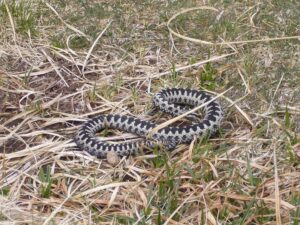
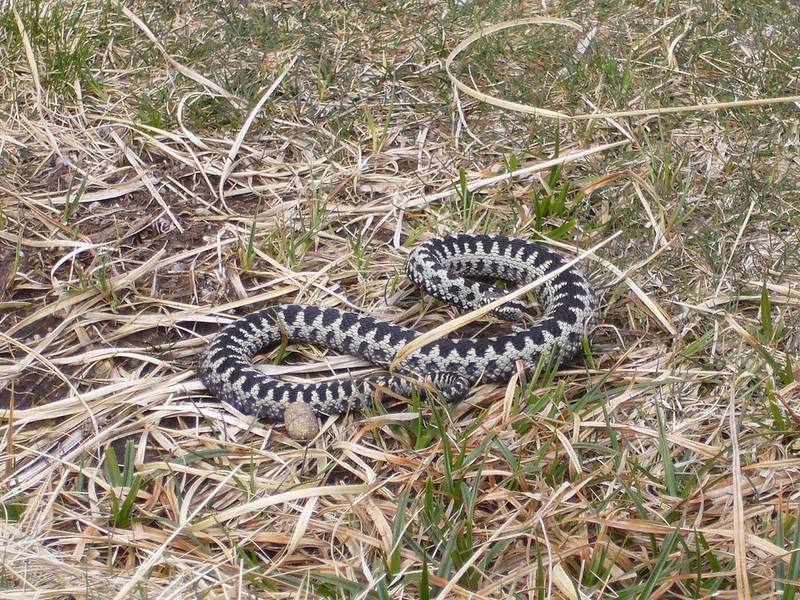
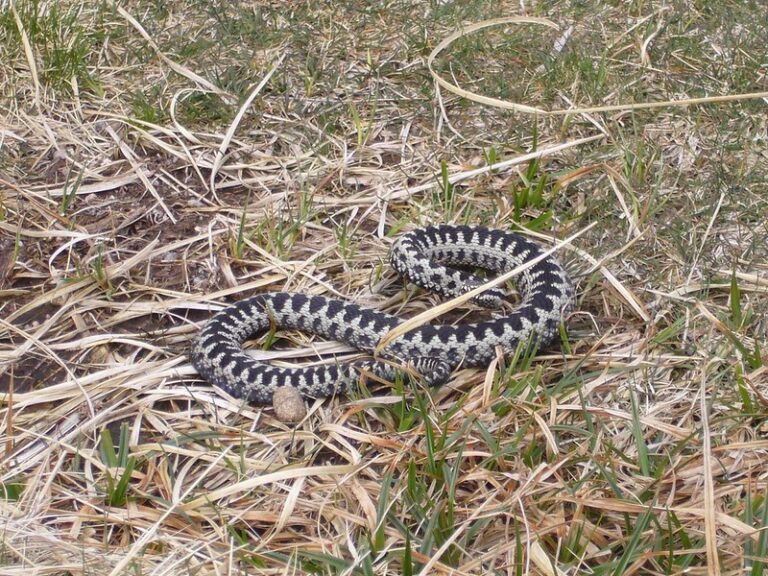
An adder is semi-curled in on itself whilst lying on dome long dry grass. It is grey with black zigzags running down its back.

Adder, Graham Tait

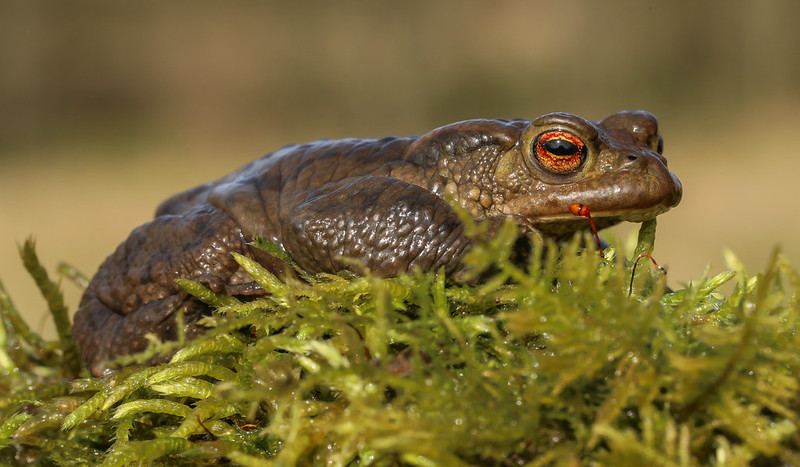
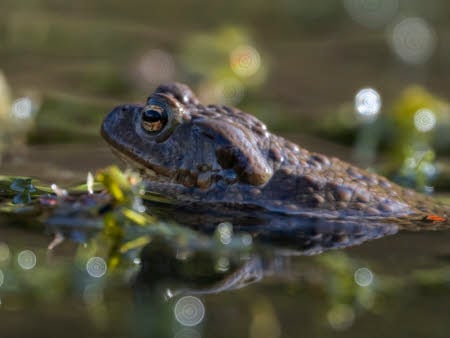
A large dark brown-green toad with orange eyes sits on a clump of moss.

Common Toad, Wayne Havenhard

1. About

Reptiles (lizards and snakes) and amphibians (frogs, newts and toads) are cold-blooded vertebrates which rely on their environment to control their temperature.

Reptiles largely live on dry land whereas amphibians need a moist environment. Amphibians breed in ponds and other waterbodies. Adults can also be found in damp places on land (under logs, stones and in dense vegetation). Both amphibians and reptiles are mainly carnivorous, eating insects and other small invertebrates. Snakes will also eat small mammals, birds and other reptiles and amphibians.

All six of Britain’s native terrestrial reptile species and five of its seven native amphibians (not Natterjack Toads or Northern Pool Frogs) live in Devon. They’re found in a wide range of habitats from heaths and moors to sunny coastal grasslands and our parks and gardens.

Reptiles:  Adder, Grass Snake, Slow Worm, Smooth Snake, Common Lizard and Sand Lizard.

Amphibians: Common Toad, Common Frog, Great Crested Newt, Smooth Newt and Palmate Newt.

All (other than Common Frog, Smooth Newt and Palmate Newt) are listed as Devon Species of Conservation Concern and all receive some level of legal protection. Smooth Snake and Sand Lizard are threatened species. However both have been re-introduced to Devon and are very restricted in distribution. As Devon has never been a stronghold for these species and as they are managed in nature reserves that are not listed as Devon Special Species. Common Toad and Adder are both Near Threatened and are listed as Devon Special Species along with Great Crested Newt, a European Protected Species.

As there are so few species in this group a brief overview of each Devon Species of Conservation Concern is given below. See Find out more below for links to more detailed information.

Sand Lizards and Smooth Snakes: The UK’s rarest reptiles. Neither species is thought to have ever been common in Devon compared to other parts of the country and they may never have existed naturally in the county. However, Sand Lizards have been introduced to Dawlish Warren SSSI (in 1994) and Braunton Burrows SSSI (2001/2) and Smooth Snakes to the Pebblebed Heaths SSSI (2009/10). To date, all introductions have been successful with new breeding populations.

Grass Snake: Britain’s longest snake which can grow up to 150 cm in length. Found in a wide range of habitats such as woodlands, wetlands, grasslands, parks and gardens that provide food, breeding and hibernation sites. Grass Snakes are good swimmers and often hunt in the water feeding on fish and amphibians. They also eat small mammals and birds. Grass Snakes are Britain’s only egg laying snake. They lay eggs in June or July in warm decomposing vegetation such as rotting logs, leaf piles and compost heaps. They hibernate in old mammal burrows, compost heaps or deep leaf or bracken litter.

Grass Snakes are widespread across Devon but there are fewer records for west Devon, Dartmoor, and Exmoor. 

Slow Worm: Slow Worms are legless lizards which are often mistaken for snakes. Unlike other British reptiles they rarely bask in the open and prefer humid, shady habitats such as tussocky grasslands, woodland edges, gardens, allotments and heaths. They feed on slow moving prey such as slugs, worms, snails and spiders and hibernate in old burrows or rotting tree stumps. Slow Worms are widespread across Devon.

Common Lizard: Found across Devon in sunny locations with good cover such as heaths, moors and coastal grasslands. Feed on worms, slugs, spiders and insects. Give birth to live young in July and August. Hibernate, often in groups, amongst rocks or dead wood.

Four of the UK’s eight non-native reptiles and amphibians are known to be present in Devon: Alpine Newt, Marbled Newt, Red-eared Slider and Wall Lizard. The Red-eared Slider is a semi-aquatic turtle. 

Alpine Newt and Marbled Newt are currently recorded in two Devon ponds. The Red-eared Slider has been recorded in five locations, including Devon Wildlife Trust’s Bystock nature reserve on the Pebblebed Heaths.   

Wall Lizards (native in mainland Europe) are known to have been released, or have escaped, into five locations at various times over the past 70 years. Two of these colonies lasted for around 30 years but are now thought be extinct. The other three colonies are near Newton Abbot, Higher Brixham and Newton Ferrers and seem to be thriving.  

Find out more about invasive non-native species.
Key pressures and opportunities

Pressures and opportunities relating to the wide range of habitats which reptiles and amphibians live in can be found in the Habitat sections of the LNRS. A key issue is connectivity of habitat to allow movement into new areas as juveniles disperse, or habitat is lost. Loss of ponds and deterioration in the condition of existing ponds is a big issue for amphibians.

Landscape Recovery Projects offer opportunities to restore heathlands and reconnect isolated fragments. Conifer plantations are often on heathland soils and have good potential for restoration, especially where there are relics of heathland flora.

The reintroduction and spread of beavers across Devon provides an opportunity for amphibians as the beavers create new wetland habitat. Annual frogspawn counts at the Devon Wildlife Trust’s Enclosed Beaver Project site in West Devon showed that breeding pairs of common frogs increased from 10 pairs in 2011 to 6,814 pairs by 2017. 

Changes to temperature or rainfall during the winter can affect when reptiles emerge from hibernation and when amphibians breed. Migration from terrestrial habitats to breeding ponds is linked to night-time temperature, so warmer winters may disrupt this.

Increased heavy rainfall events could destroy Sand Lizard nests, while fiercer storms and rising sea levels could increase erosion of sand dunes. Heathlands are more vulnerable to fire during hot, dry summers, and ponds can dry out before amphibian larvae can metamorphose into adults. 

Warmer weather is thought to be increasing the spread and severity of ranavirus outbreaks among frogs – see Disease and non-native species below. This makes it even more critical that amphibians have a range of habitats to use to help them regulate their body temperature such as shady log piles and larger ponds with areas of deeper water.

The chytrid fungus, Batrachochytrium dendrobatidis, is widespread in Britain and affects all amphibians. It causes the disease chytridiomycosis which can cause a decline in amphibian populations. Chytrid infection has been responsible for mass mortalities of amphibians in other parts of Europe. In the UK is it most likely to impact toad populations and while it’s widespread in Britain it’s not yet had the same impact as in other countries. However, any impacts are largely unknown and there are often no visible signs of the disease. Another form of Chytrid is present in captive amphibians and hasn’t yet been detected in the wild. However, it is a potential threat, especially for Great Crested Newts. 

Ranavirus is a virus which can impact on and kill all UK amphibians, but frogs and toads are most frequently reported with the disease. It can lead to local population declines of 80% in Common Frogs and can persist in aquatic environments for a long period making it hard to eradicate. Ranavirus has been reported in Devon.

Amphibian diseases are often associated with the introduction of non-native species. For example, Alpine Newts are of high concern as they carry the chytrid fungus. For more information on diseases, including signs to look out for, see Find out more below.

Great Crested Newts can hybridize with both Italian Crested Newts and Marbled Newts, although the offspring don’t always survive. Marbled Newts have escaped into Devon and a hybrid was found in 2011. Find out more about invasive non-native species.
Snakes, particularly Adders, are vulnerable to persecution. Adders are Britain’s only venomous species, but their bites usually only have local effects. No one has died from an Adder bite since 1975. Information about Adder bites, how to treat them, and how to avoid them.

Many toads are killed on roads as large numbers cross as they return to their breeding ponds in the spring. 

Fish can be significant predators of some amphibian tadpoles. Pond weeds may provide tadpoles with some refuge from fish predation, but generally, fish should not be stocked in garden ponds for amphibians. Predation by cats can have a significant effect on populations of amphibians and reptiles. 

This is a new method of surveying that involves testing a water sample for DNA. It can be used to survey for Great Crested Newts (a Great Crested Newt licence is not needed for e-DNA surveys) and some other species such as Common Frogs. It can also be used to survey for invasive species such as Alpine Newts and diseases such as Chytrid. 

2. What we need to do and where

Priority

Increase the abundance and distribution of reptiles and amphibians across Devon, particularly those identified as Devon Special Species (Common Toad and Great Crested Newt).

See Find out more for links to more detailed information on this group including management advice and records.

Devon Special Species

An adder is semi-curled in on itself whilst lying on dome long dry grass. It is grey with black zigzags running down its back.

Adder

Vipera berus

Adders are Britain’s only venomous snake; their bites are painful and can be potentially serious, but adder bites to humans or dogs are very rarely fatal.  There have only been around ten recorded cases of death from adder bites in the last 100 years, and most bites occur when the adder has been disturbed or deliberately antagonised.  Their venomous bite is used to kill prey (small mammals, amphibians, reptiles, and birds) which they swallow whole.  They are found in open habitats with plenty of sunshine, such as heathland and moorland, rough grassland, open woodland, and coastal areas; they are rarely found in gardens.  The majority of adder records come from Dartmoor, Exmoor, the Pebblebeds, Haldon and the Bovey Basin Heaths, but there are also scattered records from the rest of Devon.

Adders are 60-80 cm long, with a stocky body shape, unlike the longer, more slender grass snake.  They have a dark zigzag along their backs; males are grey with black markings while females are brown or coppery with dark brown markings.  Completely black (melanistic) adders are common in some areas. 

Adders emerge from hibernation in late February-early March and mate a month later.  The males compete with eachother, in the ‘Dance of the Adders,’ rising up with their bodies twisted together in an attempt to force each other to the ground.  The females give birth to 6-20 live young in August and September. Adders hibernate, often in groups, in frost-free locations such as south-facing, dry high ground with plenty of cover, or in disused mammal burrows.  They can hibernate from October to February, depending on local conditions.

Adder populations are under threat nationally; Make the Adder Count, a long-running citizen science project set up by ARG UK, found that 90% of the sites surveyed had small populations, with fewer than 10 adders.  On average these small populations were declining, and only 10% of sites had large populations, that were stable.  If these trends continue over the next 10-20 years, adders will be restricted to just a few sites in the UK and will be at risk of extinction.

Actions

  • Habitat management and creation – adders need dry, open habitats with sunny areas for basking, and adjacent mature vegetation to provide cover.  Heathlands and rough, tussocky grasslands are ideal.  They also need suitable locations for hibernation, such as south-facing banks, heaps of deadwood or stone piles.  Areas of scrub and bracken provide cover and are good hunting grounds, while hedges also provide safe corridors allowing the adders to move between habitats.
  • Identify areas of former or relict heathland that could be restored, to expand or connect existing heathland sites and connect isolated adder populations
  • Identify and protect key sites for adders.
  • Reduce pesticide use – these can affect adders directly, as well as reducing prey
  • Raise awareness – amongst landowners and land managers, and the public on how to manage land for adders, how to photograph them without disturbing them, and how to avoid bites to people and pets.
  • Support the effective monitoring of adder populations and the availability of up-to-date data and make sure that the data is passed to the Devon Biodiversity Records Centre.
  • Create a map showing the distribution of Adders across Devon.

Where to focus action

Areas of heathland, moorland, and conifer plantation.

Common toad, Barry Edwards - National Trust Images

Common Toad

Bufo bufo

Habitat

Common Toads are slightly smaller than Common Frogs, crawl rather than hop, and have rough, warty and relatively dry skin. The skin of adults and tadpoles contains toxins, making them distasteful to predators.

Toads lay eggs in the early spring (often a few weeks after frogs) in waterbodies such as ponds, ditches and lake. Toad spawn is easily distinguished from frog spawn as it forms long strings (not clumps). Toads have a strong migratory instinct and will follow the same route back to ancestral breeding ponds each spring.

After the breeding period (a few weeks) adult toads migrate away from ponds. They live in moist, shady well vegetated areas with lots of leaf litter, logs, rocks and dense vegetation which provides cover and food. They eat insects, slugs, snails, spiders and occasionally smaller amphibians. Like frogs, they’re mainly active at night. They spend the winter buried in mud, under compost heaps or among deadwood.

Population

The toad population has declined nationally, especially in the southern half of Britain. The main reason is thought to be due to fewer ponds and other water bodies. Toads are widespread across Devon but are far less common than frogs. They are listed as a Devon Special Species as they are near threatened and (like Great Crested Newts) are a great flagship species for pond conservation.

Great crested newt swimming / dispended in water. Dark brown with orange/yellow patches

Great Crested Newt

Triturus cristatus

Habitat

Adult Great Crested Newts are easily recognised due to their large size (they can be up to 17 cms), bright orange underside with black blotches and an impressive, jagged crest along the back of the males.  

Great Crested Newts breed in around March to June. They lay eggs in waterbodies, preferring large ponds or small lakes with abundant weeds, a neutral pH, and no fish. They’re often found in flooded mineral workings, where huge populations can develop. However, they can also breed in smaller ponds (including in gardens) and ditches. Females lay around 200 eggs, wrapping each one individually in the leaves of pond plants.

Outside the breeding season they can be found outside waterbodies. Like toads (and other amphibians) they need moist, shady well-vegetated areas with lots of leaf litter, logs, rocks and dense vegetation that provides cover and food. They can therefore be found in a range of habitats such as woodlands, dense hedges, scrub, tussocky grasslands and field margins, in rural and urban areas.

Great Crested Newts are thought to be able to travel an average of 500 m from a pond, but have been known to travel further distances, possibly up to 1.7 kms depending on habitat continuity and barriers such as large roads.

Like other amphibians they are carnivorous and will eat whatever they can find including worms, slugs, insects and tadpoles. They’re largely active at night, spending the day at the bottom of ponds or in vegetation. Great Crested Newts don’t hibernate but spend the winter under rocks or log piles, in compost heaps or buried in mud. However, in warmer weather they may come out to feed. 

Population

The Great Crested Newt population has shown huge declines in range and abundance over the last century and they’re strictly protected under British and European law.  

Devon is on the edge of their UK range, and they’re mainly found in the south and east of the county. However, they have been re-introduced to several locations in the north and west, including Braunton Burrows. They’re listed as a Devon Special Species as the majority of Great Crested Newts are found outside protected sites and as they (like toads) are a great flagship for pond conservation.

Actions for Common Toads and Great Crested Newts

Manage and create healthy habitats (waterbodies and surrounding habitat) including clusters of ponds for Common Toads and Great Crested Newts.

  • Manage existing waterbodies (ponds, lakes, ditches) for wildlife, for example, unpolluted, some fish free, vegetated. See details in Lakes and ponds.
  • Manage habitat around and between ponds (especially hedge and stream corridors) to provide moist shady well-vegetated areas and connectivity with lots of leaf litter, logs, rocks and dense vegetation.
  • Create pond clusters connected by well-vegetated habitat with a maximum distance of 500 m between ponds.

Develop safe road crossings. Raise awareness (through signs where appropriate) of major toad road crossings to reduce fatalities during the spring. Where possible create safe road crossings using culverts.

Follow best practice biosecurity measures. Follow the ‘Check, Clean, Dry’ procedure when working on watercourses to prevent the spread of invasives and disease. See Actions for all reptiles and amphibians below.

Survey, monitoring, engagement

  • Share any records of Great Crested Newts and Common Toads with the Devon Biodiversity Records Centre and Devon Reptile and Amphibian Group.
  • Continue regular Great Crested Newt surveys across Devon, through training up volunteers and local wildlife groups.
  • Raise awareness of Common Toads and Great Crested Newts and the actions needed to increase populations.

Where to focus action

High Opportunity Areas: Lakes and ponds (existing). Lakes and ponds that have been mapped are shown on the viewer. This mapping is not comprehensive and many will be missing.

Actions for Great Crested Newts should be targeted to the Species Opportunity Areas for Great Crested Newts. See Mapping.

However actions, especially the creation of new ponds, are needed across Devon.

Actions for all reptiles and amphibians

Habitat management and creation

Reptiles and amphibians are found in a wide range of habitats across Devon and will benefit from actions set out on the Habitat pages that provide food (insects, invertebrates), shelter and breeding sites. Actions relating to ponds are particularly critical for amphibians.

Biosecurity: prevent any spread of disease into the wild and between ponds.

A few critical actions are given below but see Find out more for more detailed advice.

  • Never transfer amphibians between sites or from captivity into the wild.
  • Do not transfer water or water plants where there is any risk that they are infected.
  • Clean and disinfect boots and equipment used in different ponds and other waterbodies.
  • Follow best biosecurity practice for captive amphibians such as not cleaning amphibian tanks or reptile vivaria outside and ensuring that captive amphibians cannot escape into the wild.
  • Register any incidents of death or illness with Devon Biodiversity Records Centre. Register garden deaths and illness with Garden Wildlife Health (see Find out more below for a link).

Awareness and engagement

  • Join and support the Devon Reptiles and Amphibian Group (DRAG) and other organisations and projects working to help Devon’s reptiles and amphibians. See links in Find out more below.
  • Survey and monitor species and share records with DRAG and DBRC.

3. Inspiration

Case studies

Devon Great Crested Newt project

In 2011, Devon County Council set up and funded a project to raise awareness of Great Crested Newts and to collate and verify records. The project was led by Devon Reptile and Amphibian Group in liaison with Devon Biodiversity Records Centre (DBRC) and led to the mapping of Great Crested Newt conservation zones linked to planning guidance. In 2024, DBRC found funding to resurvey ponds with old records and survey new sites. Volunteers were trained and most surveys were carried out using e-DNA testing.

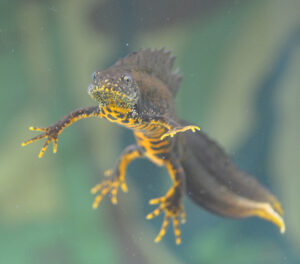
A great crested next hangs suspended in blurred blue-green water, The next has a bright yellow underbelly, under legs and feet, and tip of tail. The yellow is marked with dark grey splodges, the same colour as the top of its legs, back and tail, including the jagged crest that runs from the back of its head to the tip of its tail. The newt is facing towards the camera.

Snakes in the Heather Project (2019-2024)

The amphibian and reptile conservation (ARC) trust led this project to reintroduce Smooth Snakes across southern England and monitor their populations. The project raised public awareness, promoted community relationships and developed new tools to help conserve Smooth Snakes and other heathland reptiles. The project also developed guidance for land managers and ecologists on how to manage heathlands for reptiles.

An adder is semi-curled in on itself whilst lying on dome long dry grass. It is grey with black zigzags running down its back.

Where to visit

Always follow the Countryside Code and keep to footpaths and sites that are managed for public access. 

Good places to see reptiles and amphibians are:

The Pebblebed Heaths National Nature Reserve in east Devon is a great place to go to try and spot Common Lizards basking in the sunshine on tracks. Adders, Great Crested Newts, toads, frogs and the rare Smooth Snake are also all found in and around the heaths. Attend a Heath Week event in the summer for guided walks.

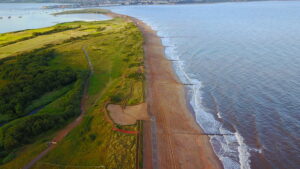
Join a guided walk at Dawlish Warren National Nature Reserve to spot the beautiful and rare Sand Lizard.

An aerial shot of Dawlish Warren with the sea to the right of the shot, the nature reserve to the left, the estuary mouth along the top and the dunes and beach running down the middle.

For information on visiting these sites and others that are open to the public please see the Explore Devon website.

4. Find out more

Amphibian and Reptile Conservation’s advice for field workers to reduce the spread of disease

https://www.arc-trust.org/amphibian-disease-precautions

Garden Wildlife Health (GWH) is a collaborative project between the Zoological Society of London, British Trust for Ornithology, Froglife and the RSPB which aims to monitor the health of, and identify disease threats to, British wildlife. The website has lots of useful information and a section allowing people to report incidents of disease and mortality.

Further information on Check Clean Dry » NNSS

  • Great crested newt – Amphibian and Reptile Conservation
  • Adder – Graham Tait
  • Common Toad – Wayne Havenhard
  • Adder – Graham Tait
  • Common Toad – Barry Edwards, National Trust Images
  • Great Crested Newt – Amphibian and Reptile Conservation
  • Great crested newt – Amphibian and Reptile Conservation
  • Adder – Graham Tait
  • Dawlish Warren – Richard Davidson

BOLD if it’s a Devon Special Species, * for Devon Special Group.

  • Adder – Vipera berus
  • Common Toad – Bufo bufo
  • Common Frog – Rana temporaria
  • Common Lizard – Zootoca vivipara
  • Great Crested Newt – Triturus cristatus
  • Grass Snake – Natrix helvetica
  • Sand Lizard – Lacerta agilis
  • Slow Worm – Anguis fragilis
  • Smooth Snake – Coronella austriaca

Draft