
Skip to content

Fish

The Spiny Seahorse and Short-snouted Seahorse live in Devon’s seagrass beds.

European Eels are now critically endangered but are still found in most Devon rivers.

The Tamar is the only river in England where Allis Shad is now confirmed to breed.

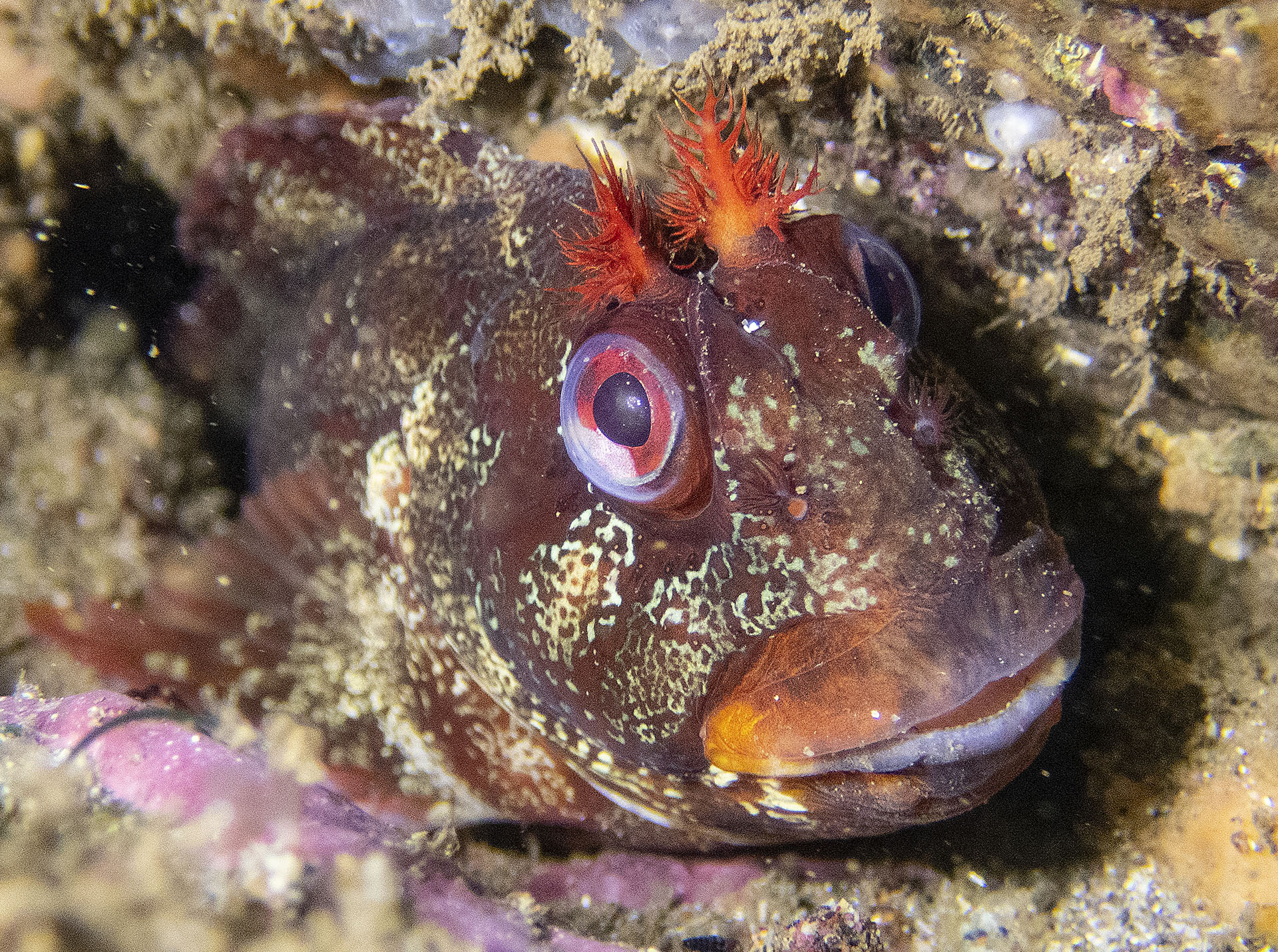
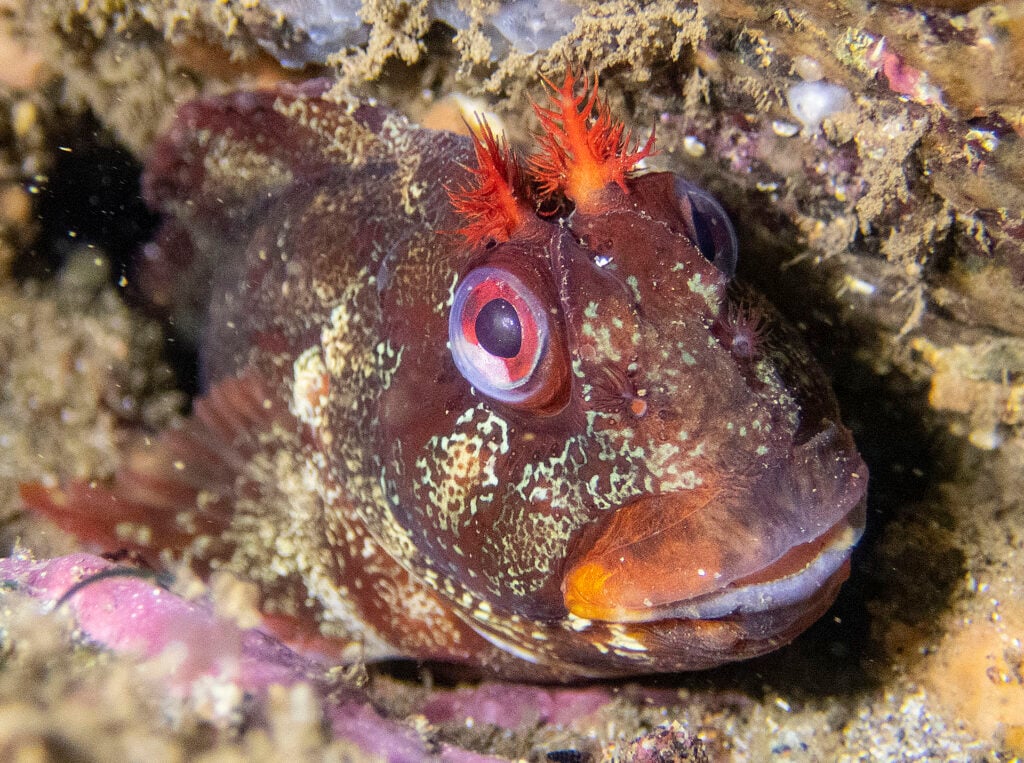
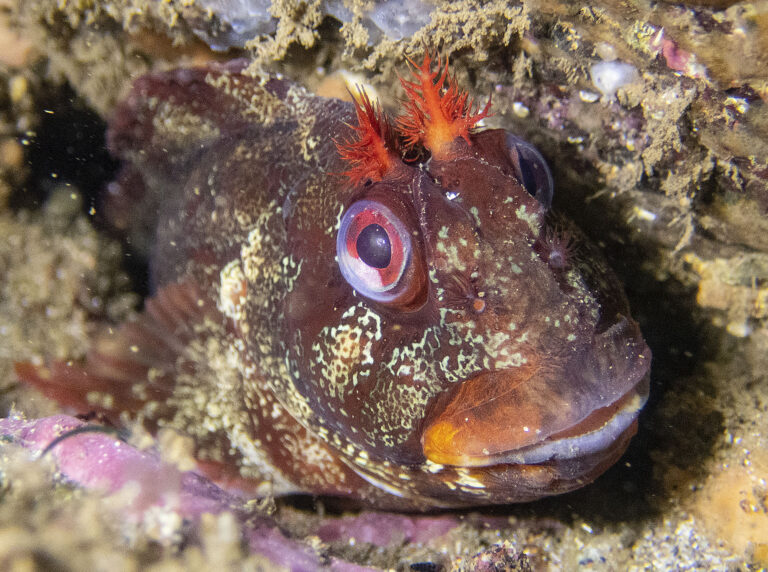
Tompot blenny with big red eyes and a bright orange coral shaped feature on its head, The fish has a wide mouth, and interesting light green patterns over its brown body.

Tompot blenny, Paul Naylor, marinephoto.co.uk

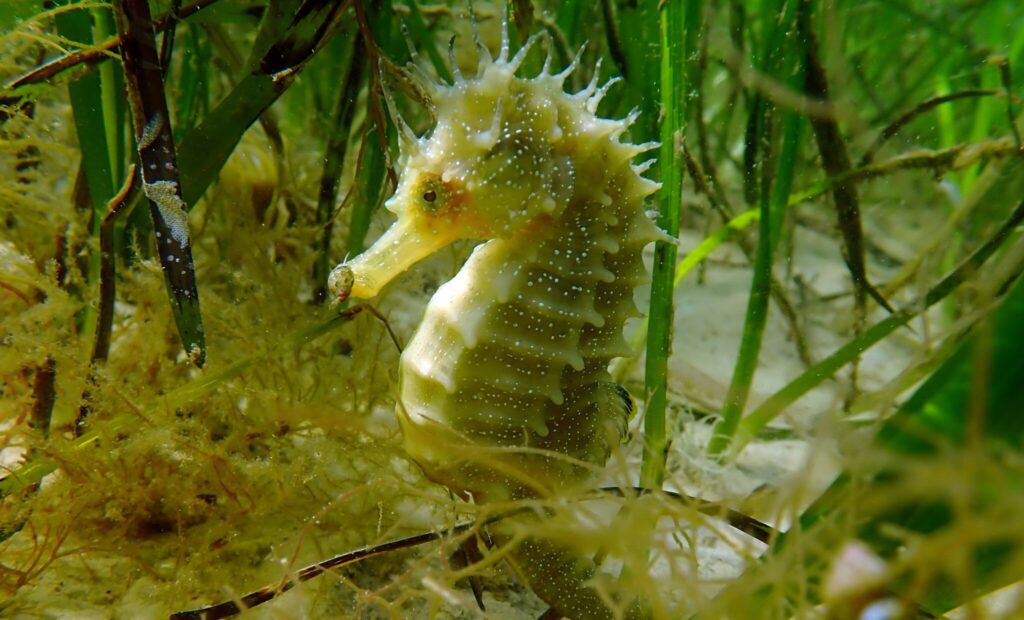
A pale yellow seahorse with fleshy spikes along its back, is partially visible poking through some seagrass against a sandy seabed floor.

Hippocampus guttulatus, Neil Garrick-Maidment, The Seahorse Trust

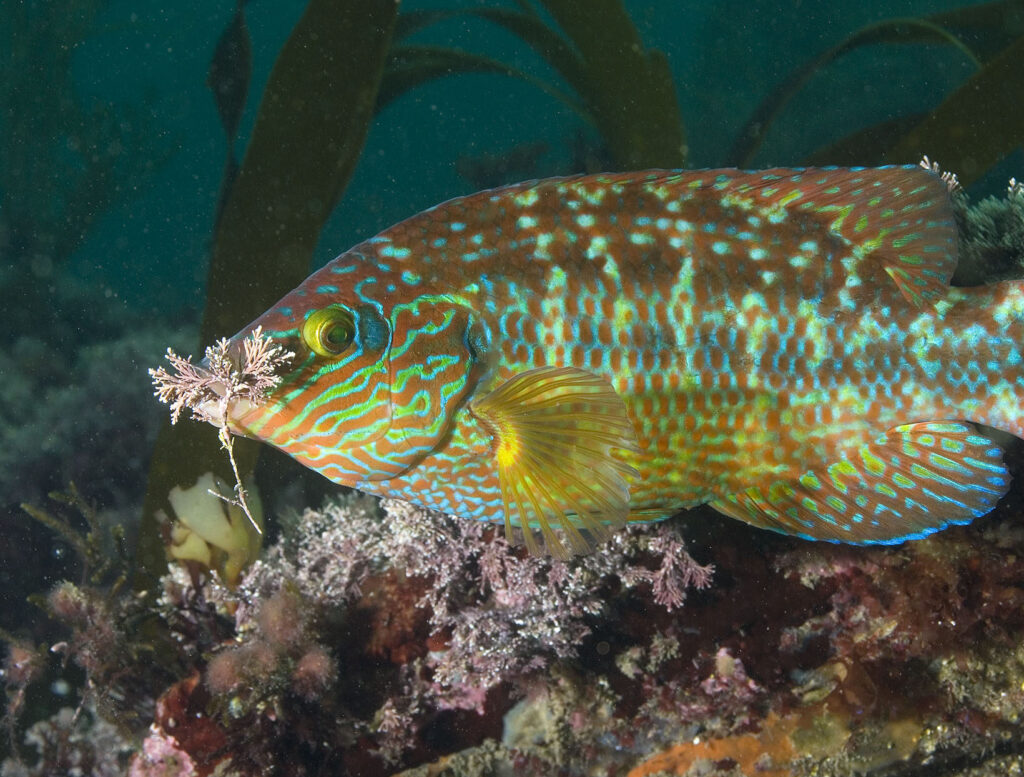
A very colourful, large fish with vibrant blue, green, brown, and orange stripe markings eats some pink coral whilst swimming along the sea floor.

Corkwing wrasse, Paul Naylor, marinephoto.co.uk

1. About

This section focuses on the fish found in Devon’s rivers, lakes, small streams, canals, estuaries and other intertidal habitats.

Fish are an integral part of balanced healthy ecosystems. They feed on invertebrates and algae and provide food for birds (including kingfishers and herons), otters and larger fish. They are sensitive to pollution and changes in oxygen levels, temperatures and water flows and so are indicators of a healthy environment.

Many Devon communities have strong commercial fishing traditions and historically fish have provided both food and livelihoods. Freshwater fish still provide recreational opportunities such as angling, which generates revenue to local businesses, communities and the economy and can increase tourism.

Some of Devon’s fish such as Bullhead, Bream, Stickleback and Chub live entirely in freshwater. Some such as Atlantic Salmon, Twaite and Allis Shad, Sea Trout, European Eel and Sea Lamprey have incredible lifecycles and migrate between the sea and our rivers. Others such as seahorses and the Tompot Blenny live in intertidal habitats.

Fish need healthy habitats to survive including:

  • Clean, well-oxygenated spawning beds with suitable gravel. Most freshwater fish lay their eggs between the tiny gaps in gravel beds that provide oxygen and refuge for eggs and emerging fry and juvenile fish.
  • An abundance and variety of food including invertebrates such as aquatic insects, crustaceans, and molluscs.
Key pressures and opportunities

Historically, many of Devon’s riverbeds, banks and channels were modified by draining, dredging, straightening, reinforcing, abstracting, removing vegetation and trees and building structures in the river. This has had a significant impact on the natural habitats in the river such as pools, gravels and vegetated banks, which fish rely on.

Weirs and other structures have significant impacts on natural river function and habitats. They can create barriers to migratory fish moving from the sea to their spawning beds in rivers, or cause unnecessary delays and exertion of energy that the fish need to spawn successfully.

Structures in rivers can completely alter the habitats fish need. They can change the flow of water and create artificially deep and slow-flowing areas lacking habitat complexity. Features such as clean gravels and shallow pools (critical spawning and juvenile habitats) are often lost and replaced by large areas of river bed with little variation in depth or structure.

Structures such as hydro-power turbines and pumping stations can trap fish, injuring or killing them.

Removal of barriers should always be prioritised because this is the only option that will restore natural river function and free passage for fish. However, in some cases this can be challenging due to factors such as the historic value of weirs or an increased risk of flooding to urban areas. Other options include fish passes and easements (simpler solutions to help fish move past barriers) which facilitate fish passage but do not completely restore natural river function.

Channels and banks that have been made too wide or too deep often completely disconnect the river from its flood plain. However, this connection is vital to support the river’s health and to create the specific habitat fish species need in their juvenile life stages.

Fish can be very sensitive to changes in water quality, which if they exceed tolerance levels can cause stress, disease, hormone imbalances, inhibit growth, impact successful spawning, or even death. Sources such as agricultural runoff, sewage and wastewater inputs, industrial chemicals, and legacy inputs such as mining leachate can all have devastating consequences for fish and other species.

Reduced water flows can prevent fish from reaching the important habitats they need for feeding, refuge and spawning. Groups can be isolated in areas with insufficient habitat. Lower, slow-moving flows often heat up more quickly, causing dissolved oxygen levels to drop which can harm or even kill sensitive species such as trout and salmon.

In contrast, increased flows can cause more erosion, which can smother spawning gravels, eggs and juvenile fish or even wash away spawning gravel and aquatic vegetation completely.

Many watercourse corridors are now overgrazed or unmanaged. This can create large, open sections of river that are prone to higher water temperatures or heavily shaded areas that reduce the amount of sunlight getting to the river. This in turn restricts the growth of plants and algae that are food for fish and the invertebrates they feed on. A healthy mosaic of native tree species and bankside vegetation is crucial to slow flows and run-off from nearby fields and roads and acts as a buffer for reducing input.

A lot of litter and plastics ends up in Devon’s rivers and seas. Fish often get caught up in items such as plastic bags, fishing line and other bits of debris, which can injure or kill them. Fish also mistake litter for food, which when they eat it causes digestive blockages and has toxic effects, particularly on the hormonal system. These toxins often work their way up the food chain where they can affect birds and otters that eat fish, and even humans.

During their marine life stage, many species such as Atlantic Salmon can become accidentally caught as bycatch by commercial fishermen as they share the same behaviour as other marine species. Although they’re usually released, the likelihood of the fish surviving after being caught in nets is low.

Species such as the European Eel are often caught and illegally targeted to be sold on the black market, especially those at juvenile stages.

Although there are now byelaws that require catch and release for species such as Atlantic Salmon, they are still ignored.

Angling and rod license sales provide valuable income that is often directed back to making improvements to rivers. Valuable rod catch return data is used to help assess stock health, monitor fishing pressure and inform conservation efforts.

Key impacts of climate change include:

– Rising water temperatures which reduce dissolved oxygen levels making fish more vulnerable to stress and disease. This can also produce niches for non-native species to thrive, helping them outcompete native species.

– Longer dry periods, reduced rainfall and more frequent droughts causes reduced river flows and lower water levels (see Water quality and flows above).

There are lots of projects across Devon that provide opportunities for fish conservation, many led by the Environment Agency and Westcountry Rivers Trust (WRT). See Inspiration and Find out more below for more information.

There are an increasing number of communities across Devon taking action for watercourses and estuaries. WRT runs the Westcountry Citizen Science Investigations, which aims to educate and engage people with the water environment, spot pollution events, produce data to target works, and create a network of catchment communities.

WRT’s volunteer projects include: tree planting, litter picking and river clean-ups, clearing invasive non-native species, running sustainable and responsible angling practices fand numerous education workshops for local communities, schools and organisations.

2. What we need to do and where

Priority

Support the recovery of fish populations, particularly Devon Special Species, by protecting and enhancing habitats and addressing pressures. Where evidence indicates, explore opportunities to increase abundance and distribution.

See Find out more below for links to more detailed information on this group including management advice and records.

Devon Special Species

Tompot blenny with big red eyes and a bright orange coral shaped feature on its head, The fish has a wide mouth, and interesting light green patterns over its brown body.

Rockpool fish group

These fascinating and engaging group of fish live in the intertidal zone of rocky shores. Some species are widespread and familiar, others are unusual, rarely seen and enigmatic. 

Almost all the species depend on rockpools for food and/or reproduction, with many of them being territorial and exhibiting an impressive degree of care for their eggs. 

With its extensive rocky beaches, Devon provides some of the best habitats for these fish in the UK, but Devon’s popularity as a destination for seaside holidays also means that these environments can be especially vulnerable to human disturbance. 

In addition to human disturbance, general pressures may include increased frequency of storms (importantly including in the spring and summer breeding season) linked to climate change and alterations of prey and parasite distribution due to shifting sea temperature.

Whilst all are discussed individually below none are listed as a Devon Special Species in their own right.

Tompot blenny with big red eyes and a bright orange coral shaped feature on its head, The fish has a wide mouth, and interesting light green patterns over its brown body.

Tompot Blenny

Parablennius gattorugine

A relatively large blenny occasionally found in pools on the lower shore, distinguished by two bushy head tentacles and more reddish-brown colouration than Shannies and Montagu’s Blennies. Research in Devon using their unique skin markings to recognise individuals shows that a tenacious male can keep his territory where he guards eggs for over seven years. Aptly described as ‘The small fish with a big personality’ in the media.

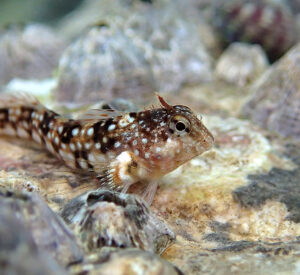
A very small fish lies along the bottom of a rocky seabed covered in grey limpets. The fish is very pale brown with darker brown stripey markings and white dots.

Montagu’s Blenny

Coryphoblennius galerita

A small blenny, similar in form and habits to the larger and more widespread Shanny (Lipophrys pholis) but distinguishable by a crest on the top of its head. This can be hard to see as the little fish darts around rockpools. Montagu’s Blennies have a mainly south-west distribution in Britain and prey particularly on barnacles, nipping off their limbs as they feed. Territorial males guard eggs laid in rock crevices.

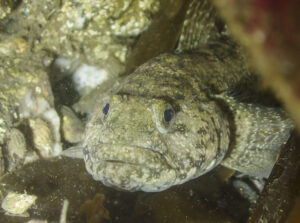
A mottled green-grey, rock-like fish, with black eyes and large wide lips, lies between rocks of a similar colouring.

Giant Goby

Gobius cobitis

This rare species has a scattered distribution with important locations in Devon and is protected under the Wildlife and Countryside Act. It lives mainly in intertidal rockpools among green seaweeds and so is particularly vulnerable to disturbance from nets being swept through pools. It is distinguished from other gobies by its size, overall greenish speckling on a pale background and relatively small eyes.

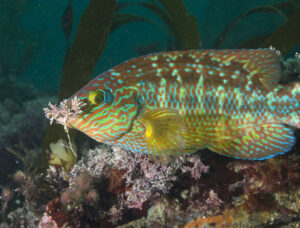
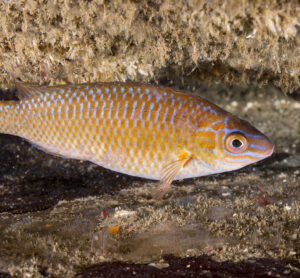
A very colourful, large fish with vibrant blue, green, brown, and orange stripe markings eats some pink coral whilst swimming along the sea floor.

Corkwing Wrasse

Symphodus melops

Brilliantly coloured male Corkwings build a nest of seaweed fragments where the females lay their eggs. Some of these nests can be found on the shore, exposed at low tide, not a mistake but an alternative strategy to subtidal nests. Research in Devon in the 1980s revealed the intricacy of the nest-building process. Different types of seaweed are used for different parts of the nest, for example, and intertidal nests are built on north-facing rocks to ensure they remain shaded and cool when then tide is out.

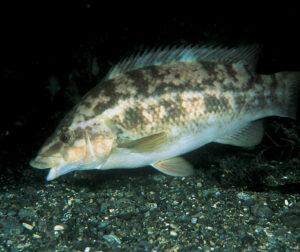
A pale brown fish, with darker mottled brown markings and a white underbelly, swims open mouthed along a gravelly seafloor against a black sea.

Ballan Wrasse

Labrus bergylta

This is the largest and most heavily built of our wrasse and impressive individuals are often seen intertidally where they feed on invertebrates such as limpets, mussels and crabs. Strong conventional teeth, supplemented by extra teeth in their throat, enable them to break the shells of their prey. Ballan Wrasse exhibit a range of colours and patterns; juveniles may be a bright green and hide among similarly coloured Sea Lettuce (Ulva lactuca). They mature first as females with some individuals later changing into males.

A vibrantly coloured fish swims against a pale rock. The fish is predominantly reddy-orange with narrow blue line markings and a round orange and black eye.

Rock Cook

Centrolabrus exoletus

This is the smallest British Wrasse and is usually seen in subtidal groups although very young fish may be seen on the shore. It is the only species generally seen engaged in ‘cleaning’ activity in the wild, although all four wrasse species listed here have previously been caught (in a fishery regulated by Devon and Severn IFCA) and taken to be used for removing parasites from farmed salmon. The taking of Rock Cooks was specifically prohibited in 2020 due to concern over their numbers and the wrasse fishery has not operated in Devon since 2021.

Actions

Encourage responsible rockpooling by sharing simple Seashore Codes and local Codes of Conduct on signs, QR codes, and on Information panels.

Discourage activities like “mini-angling” and catch‑and‑release, as they disrupt territories and fish guarding eggs.

Support local conservation goals, such as those in the Wembury Marine Conservation Area.

Where to focus action

High Opportunity Areas: Coastal wildbelt, estuaries, existing seagrass beds and seagrass restoration opportunity areas. See Mapping.

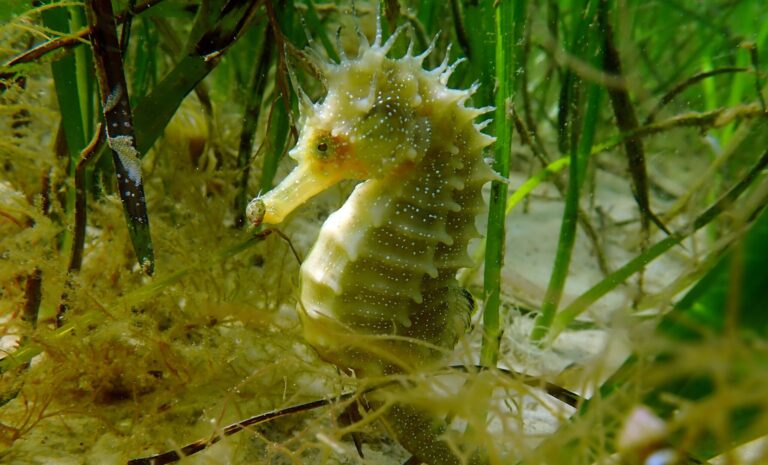
A pale yellow seahorse with fleshy spikes along its back, is partially visible poking through some seagrass against a sandy seabed floor.

Seahorses

Seahorses lead solitary and secretive lives in sheltered, shallow, coastal waters. The Spiny Seahorse and Short-snouted Seahorse live in Devon’s seagrass beds, which are largely found on the coast around Torbay, Plymouth, the Exe Estuary and Kingsbridge. Seahorses are well-camouflaged, blending seamlessly into their surroundings and using their tails to anchor themselves to seagrass blades, where they prey on small crustaceans such as shrimp and crabs.    

One of the most intriguing aspects of seahorses is how they reproduce. Unlike most fish, the males carry the fertilised eggs in a special brood pouch and give birth to live young.

Devon’s seahorses are both endangered species due to habitat destruction, especially the loss of seagrass meadows. Seahorses are often caught as bycatch in trawl fisheries and are also globally harvested for traditional medicine. The demand globally for seahorses in traditional medicine and the aquarium trade is high compared to many other fish species. 

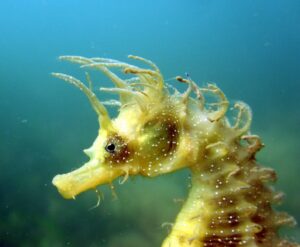
The head and neck of a pale yellow seahorse with long strands along its back and the top of its head, can be seen against a blue-green sea.

Spiny (Long-snouted) Seahorse

Hippocampus guttulatus

The Spiny (Long-snouted) Seahorse has a slender, elongated body with a long snout and is typically between 18 and 20 cm long, although many are recorded to be larger. Its coloration ranges from dark green to brown and yellow, often speckled with small white dots. True to its name, this species is adorned with distinctive spiny protrusions along its head and back.

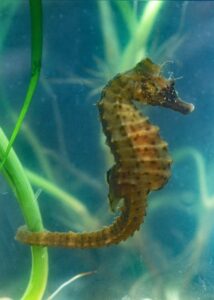
A dark brown seahorse, with red undertones, swims against a backdrop of blue sea and green seagrass.

Short-snouted Seahorse

Hippocampus hippocampus

The Short-snouted Seahorse can grow up to 15 cm long. It has a short, slightly upturned nose, and spiky bumps above its eyes. Its body is covered in hard, knobbly lumps, which give it a rough texture. These seahorses come in many colours, including brown, orange, purple, or black, and sometimes have light patches on their skin.

Actions

Protect and restore seagrass beds, See Coastal wildbelt for more information and actions including eco-friendly moorings.

Reduce pollution and litter. See Coastal wildbelt for more information and actions.

Assess and, where required, reduce impacts from bycatch. See Coastal wildbelt for more information and actions.

Raise awareness about the importance of seahorses and their habitats, including with tourism boards. Engage local communities and schools in citizen science projects, beach clean-ups, and activities to restore habitat.

Where to focus action

High Opportunity Areas: Coastal wildbelt, estuaries, existing seagrass beds and seagrass restoration opportunity areas. See Mapping to view the intertidal seagrass layer.

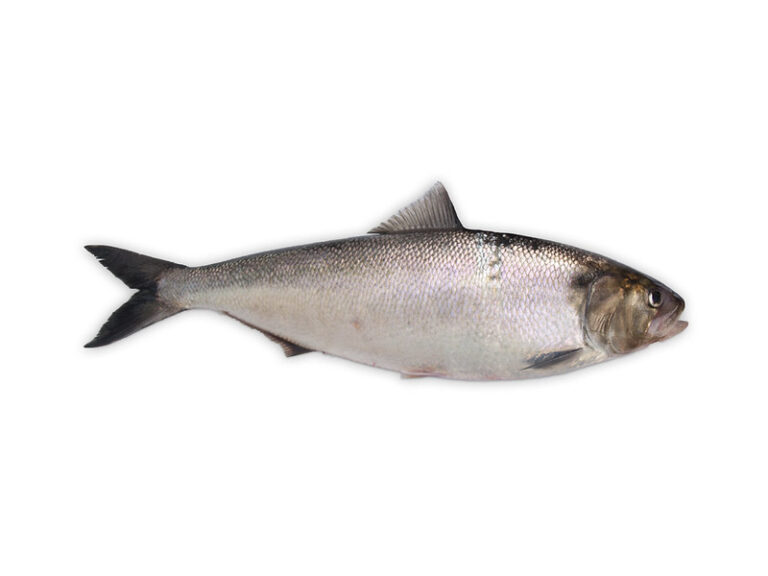
A dead Allis Shad specimen against a white background. The fish is predominantly silver with darker fins and head.

Allis Shad and Twaite Shad

Alosa alosa and Alosa fallax

Habitat

Both shad species are members of the herring family and move from the sea into rivers to spawn between April and June. They spawn in gravels and cobbles in shallow areas (less than 1.5 m) with high flows. Juvenile fish live in areas with low flows and very slow flowing water along the river edge (known as ‘dead water’).

Population

Both allis shad and twaite shad are protected under Schedule 5 of the Wildlife and Countryside Act 1981. Once widespread, both species have declined significantly in recent decades, and allis shad is now critically endangered. The River Tamar (below and just above Gunnislake Weir) is the only confirmed spawning river for allis shad in England. Shad are also known to be present in the Taw, with eDNA testing underway to confirm species and distribution. 

Twaite shad are generally more widespread than allis shad, but records in Devon remain sporadic. In practice, the two species are difficult to distinguish, so conservation efforts should focus on their overall decline and need for protection. 

Both species are strong swimmers but struggle to pass weirs and other barriers, which can prevent access to upstream spawning grounds. Other pressures include water quality, river modification, and bycatch. Management of migratory fish such as shad and salmonids falls under the remit of the Environment Agency (EA), which enforces relevant byelaws and regulations, including restrictions on netting and catch-and-release requirements for salmonids.

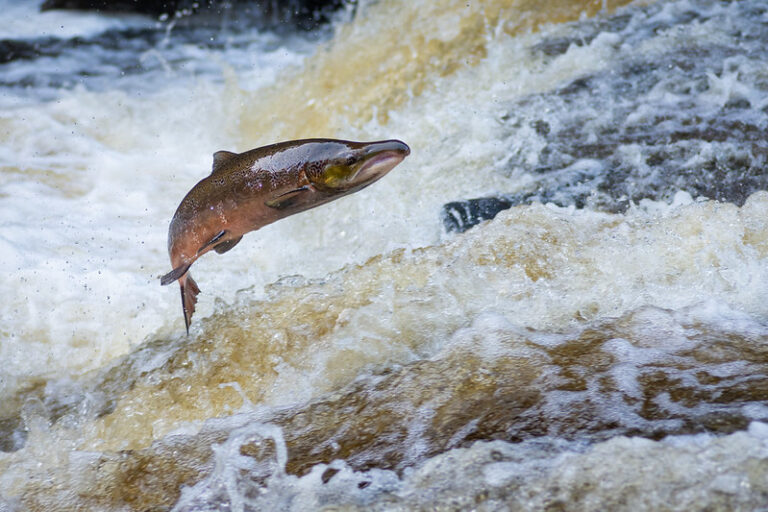
An Atlantic Salmon is leaping up a small white waterfall.

Atlantic Salmon

Salmo salar

Habitat

Atlantic Salmon move from the sea to spawn in the middle to upper reaches of rivers where there is clean, cooler, fast-flowing water. They lay their eggs in shallow gravelly areas in nests called redds. Adult salmon usually die after spawning. Juveniles stay in freshwater for 1 – 3 years after which they migrate back to the sea. They feed on invertebrates and small fish. 

Population

Wild Atlantic Salmon populations are in crisis, having declined by 70% in the last 25 years and the Atlantic Salmon is now endangered in Britain. In the 1980s there were 8-10 million adult salmon in the North Atlantic. Today there are 2-3 million.

There are 13 principal salmon rivers in Devon: the Axe, Exe, Teign, Dart, Avon, Erme, Yealm, Plym, Tavy, Taw, Torridge, Lyn, and Tamar. In 2022 all were classified as ‘At risk’ apart from the Tamar and Lyn which were ‘Probably at risk’. Particular pressures in Devon include barriers, water quality, sediments smothering gravel beds, higher water temperatures and altered flows. 

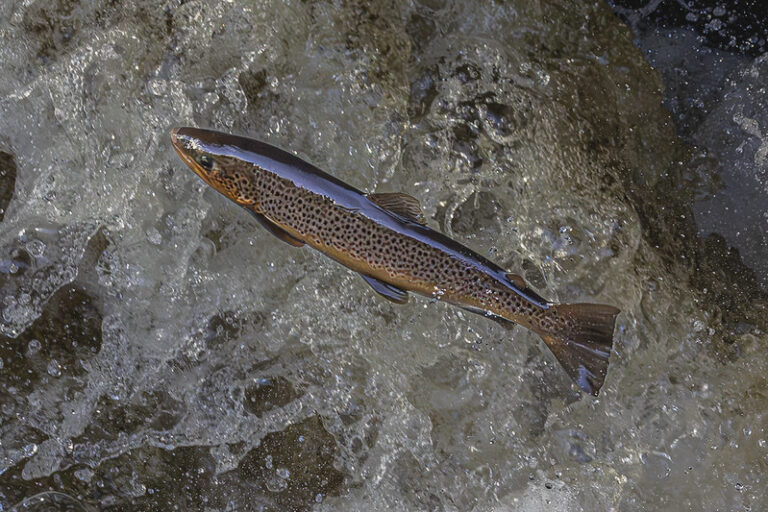
A Brown Trout leaps up a small waterfall with fast flowing white water in the background.

Sea and Brown Trout

Salmo trutta morpha trutta and Salmo trutta

Habitat

Sea and brown trout are the same species. Like salmon, trout also require clean, well oxygenated gravel to spawn but prefer finer gravels and can also use smaller streams and rivers. They use vegetation and woody debris as refuges. Unlike salmon, trout don’t usually die after spawning. Some stay in rivers and are known as Brown Trout and others migrate out to sea and are known as Sea Trout. Many return to the same river to spawn, generally between June and October.   

Population

Due to the decline in Sea and Brown Trout populations, byelaws have been put in place restricting the number of fish that can be kept and killed. Much of the data held on Sea Trout stocks in the UK is from fishermen who hold rod catch licences. In Devon, the Avon, Plym and Torridge are now classified as ‘At risk’ with the Dart, Erme, Yealm, Tavy, Tamar, Taw and Lyn classified as ‘Probably at risk’. Pressures for trout are very similar to those for salmon.

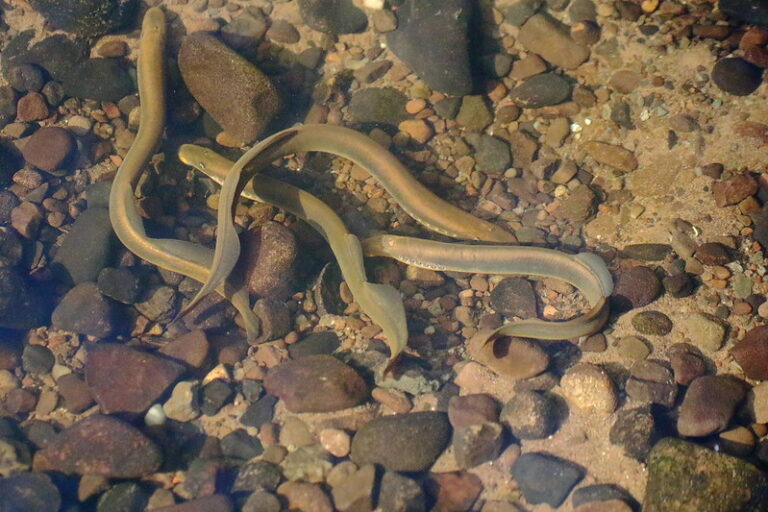
Several lamprey can be seen swimming along a stony river bed with the image taken from above.

Sea Lamprey, Brook Lamprey and River Lamprey

Petromyzon marinus, Lampetra planeri and Lampetra fluviatilis

Habitat

Lampreys are an ancient order of jawless fish. They have a circular disc-shaped mouth, which Sea Lamprey use to attach themselves to a host fish they then feed on. Brook Lamprey live in freshwater, while River and Sea Lamprey spawn in freshwater and feed in coastal waters. However, Brook and River Lamprey could be the same species, with some fish staying in freshwater and some evolving to be able to migrate out to sea (similar to Brown and Sea Trout).

Population

All three species are of international conservation concern. Brook Lamprey is legally protected and all are UK Priority Species. There are no specific lamprey surveys in Devon, but an analysis of Environment Agency data from 1965-2024 showed:

  • Brook Lamprey are likely to occur in most of Devon’s catchments
  • Sea Lamprey were found in the Taw and other north Devon catchments, Axe and Tamar
  • River Lamprey were in the Lim, Axe and Torridge catchments.

The main pressures are river barriers preventing access to their spawning gravels, pollution and loss of habitat through straightening and deepening channels in rivers.

Image needed

European Eel

Anguilla anguilla

Habitat

Eels follow an opposite lifecycle to salmon, trout, shad and lamprey. They spawn in the Sargasso Sea and then travel across the Atlantic to mature in rivers for up to 20 years before they return to their spawning ground. They have a broad diet that includes fish, molluscs and crustaceans and are also known to scavenge dead fish. 

Population

Eels are found in rivers across Devon. However, they’ve seen huge declines and are now critically endangered in Great Britain. Threats to eel populations in the UK are barriers to migration, habitat loss, fragmentation and degradation, pollution, overfishing, illegal capture and climate change.

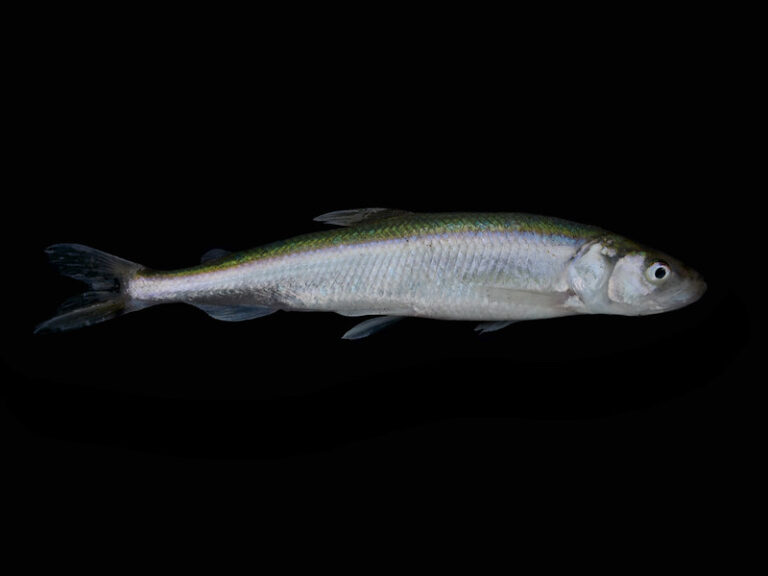
A European Smelt swims through still, black water with its silver body standing out against the black.

European Smelt

Osmerus eperlanus

Habitat

The European Smelt is a small fish that spends most of its life in coastal and brackish waters but migrates into rivers to spawn. In winter, smelt gather near river mouths, and between February and April they swim upstream to lay eggs before returning to the sea. They are rarely found far from the shore and prefer sheltered midwater habitats. In Devon, they can occasionally be seen near estuaries during their seasonal migration.

Population

The population of European Smelt is in steady decline. The Tamar Estuary remains one of the most significant breeding grounds, and its designation as a Marine Conservation Zone is vital to safeguarding the species.

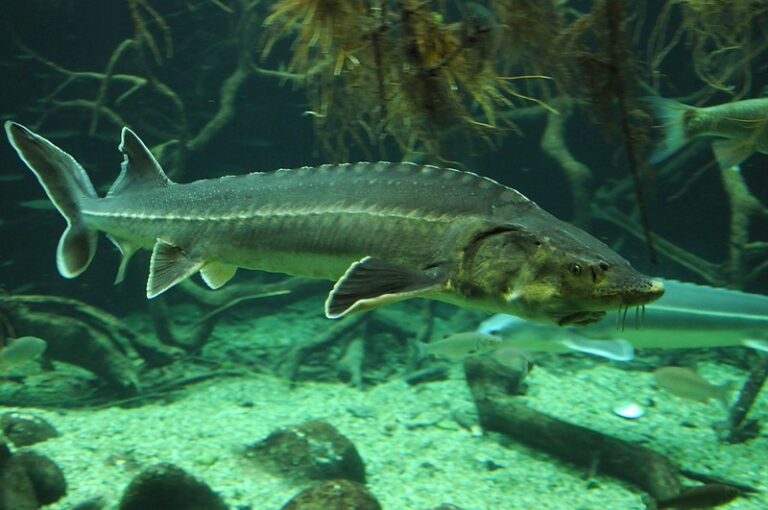
A large European sturgeon swims in green-blue water with seaweed and other fish partially visible in the background.

European Sturgeon

Acipenser sturio

Habitat

Sturgeons migrate from the sea to freshwater rivers to spawn and need diverse habitats, including estuaries and intertidal zones, which provide critical feeding and nursery grounds. Some sturgeon species can grow to be over six metres long and weigh more than 1,000 kilograms.

They have long, torpedo-shaped bodies that are covered in bony plates rather than scales. Their mouths are on the underside of their heads and can extend to suck up small worms and crustaceans from sediments. Their feeding habits help to aerate the riverbed and redistribute nutrients.

Population

There have been at least ten records of sturgeon off Devon’s coastline in the last few years making this nationally very rare fish ‘fairly frequent’ in Devon. There are no known records of sturgeon within Devon freshwater habitats.

Actions for migratory fish

See Watercourse corridors for actions relating to, for example, water quality, management of the riparian zone and river restoration. See Coastal wildbelt for actions relating to estuaries.

Remove barriers to improve fish passage

Develop a comprehensive barrier inventory, using existing datasets from the Environment Agency, The Rivers Trust, and the AMBER project. This is essential in order to understand the scale and impact of in-river barriers and target action. Each barrier can then be assessed for:

  • Type and passability
  • Impact on different fish species and life stages
  • Effect on river connectivity and habitat fragmentation

Develop a catchment-wide prioritisation plan to target action to where it’s most needed and to align restoration efforts with areas failing Water Framework Directive targets for fish and/or where reconnecting habitats will have the most impact.

Reduce marine impacts on migratory freshwater fish

  • Prevent overfishing in marine and estuarine areas. Overfishing can reduce adult populations before they reach spawning grounds. This is especially critical for species already under pressure from habitat loss and pollution in rivers.
  • Prevent and reduce bycatch. The accidental capture of non-target species in commercial fisheries poses a major threat. Migratory fish are often caught in nets or gear intended for other species, leading to injury or death and further reducing breeding populations.
  • Reduce disruption of migration routes by intensive fishing activity or marine infrastructure. This can delay or prevent fish from reaching freshwater systems, impacting reproduction and population resilience.
  • Improve international and cross-sector collaboration. This is essential to address these issues, as many of these species travel vast distances across jurisdictions.

Research and monitoring

Effective conservation of freshwater fish relies on robust data to identify pressures, track trends, and guide targeted action. Several key monitoring methods support this:

  • Electric Fishing Surveys: A primary tool for assessing fish populations, species diversity, and life stages across large areas in short timeframes. Complementary methods like eDNA offer presence/absence data but less detail on population density trends.
  • Walkover Surveys: A cost-effective way to assess entire river sections. These surveys identify barriers, habitat degradation, pollution sources, invasive species and key fish habitats such as spawning grounds. Findings inform restoration plans and mitigation measures.
  • Tagging and Tracking: Techniques such as PIT tagging and fish counters (for example at Gunnislake Weir) help monitor migration, survival rates and barrier impacts. Traps also allow for detailed analysis and sampling of individual fish.
  • Water Quality Monitoring: Measuring parameters like nutrients, temperature, oxygen and turbidity helps detect pollution and assess habitat suitability.

These data-driven approaches not only inform conservation but also help engage communities and stakeholders. By translating complex findings into accessible formats—like story maps, visuals, and community presentations—we can build local support and demonstrate the tangible benefits of fish recovery efforts.

Where to focus action for migratory fish

High Opportunity Areas:

All watercourse corridors and estuaries. The species discussed above occur in most of Devon’s watercourses and estuaries. See Mapping.

Actions for all fish

Habitat management and creation

Fish will benefit from the actions set out on the Habitat pages, in particular:

3. Inspiration

Case studies

Removing barriers

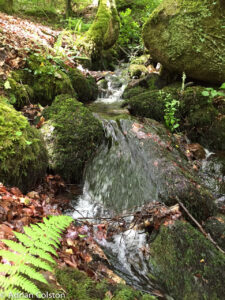
The Westcountry Rivers Trust is leading a project to assess and map barriers on the River Teign. The project is funded through the government’s Water Environment Improvement Fund. They’re also working to address barriers in the Exe catchment through the Strategic Exe Weirs project. 

Shallow, fast flowing stream over mossy rocks and ferns.

The Seahorse Trust

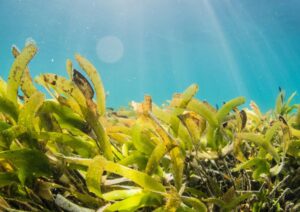
The Seahorse Trust focuses on the conservation and preservation of seahorses and their natural habitats. Through their British Seahorse Survey, the trust’s team has been conducting dives to monitor and protect Devon’s seagrass meadows.

Thick, light green seagrass grows along the seabed at the bottom of the photo, and along the top sun rays can be seen penetrating blue sea.

4. Find out more

Pisces : Fish | NBN Atlas

The AMBER project (adaptive management of barriers in European rivers) has a map of river barriers in Europe.

The Westcountry Rivers Trust study into the decline of adult trout in Dartmoor’s streams.

Taw and Teign Fisheries Management

Roadford Mitigation Programme 

SWW environmental mitigation commitments including Gravel augmentation 

Strategic Exe Weirs 

River Teign Restoration Project 

Northern Devon Natural Solutions 

Upstream Thinking 

Strategic Teign Barriers 

The Wild Trout Trust has information on the lifecycle of Sea Trout.

The SAMARCH project is a partnership between five organisations in England and five in France that work together to collect new information on the biology and ecology of migrating salmon and sea trout, to improve their protection in estuaries and coastal areas.

In 2008 the Atlantic Salmon Trust produced a booklet, Sea Trout Facts.

The Woodland Trust has a page on its website with information on Brown Trout.

The government produce an annual report on the status of salmon stocks and fisheries in England and Wales.

The Canal and River Trust has pages on its website with information on Brook Lamprey, River Lamprey and Sea Lamprey.

NatureScot,Scotland’s nature agency, has a page on its website with information on lamprey.

To find out more about seahorses and work that’s taking place to conserve them, visit The Seahorse Trust and Project Seahorse.

BOLD if it’s a Devon Special Species, * for Devon Special Group.

  • Allis Shad – Alosa alosa
  • Atlantic Salmon – Salmo salar
  • *Ballan Wrasse – Labrus bergylta
  • Bass – Dicentrarchus labrax
  • Black-face Blenny – Tripterygion delaisi
  • Couchi’s Goby – Gobius couchi
  • *Corkwing Wrasse – Symphodus melops
  • European Eel – Anguilla anguilla
  • European Sturgeon – Acipenser sturio
  • European Smelt – Osmerus eperlanus
  • *Giant Goby – Gobius cobitis
  • Goldsinny Wrasse – Ctenolabrus rupestris
  • *Montagu’s Blenny – Coryphoblennius galerita
  • Plaice – Pleuronectes platessa
  • Raitt’s SandeelAmmodytes marinus
  • *Rock Cook (Wrasse) – Centrolabrus exoletus
  • Sea Trout – Salmo trutta
  • Short-snouted Seahorse – Hippocampus hippocampus
  • Spiny (Long-snouted) Seahorse – Hippocampus guttulatus
  • *Tompot Blenny – Parablennius gattorugine
  • Twaite Shad – Alosa fallax
  • Whiting – Merlangius merlangus
  • Dover Sole – Solea solea
  • Tompot Blenny – Paul Naylor marinephoto
  • Montagu’s Blenny – Paul Naylor marinephoto
  • Giant Goby – Paul Naylor marinephoto
  • Corkwing Wrasse – Paul Naylor marinephoto
  • Ballan Wrasse – Paul Naylor marinephoto
  • Rock Cook – Paul Naylor marinephoto
  • Hippocampus guttulatus – Neil Garrick-Maidment, The Seahorse Trust
  • Spiny (Long-snouted) Seahorse – Neil Garrick-Maidment, The Seahorse Trust
  • Short-snouted Seahorse – Keith Hiscock
  • Allis Shad – Fernando Coello Vicente
  • Atlantic Salmon – Greg Parsons
  • Brown Trout – Keith Simpson
  • Lamprey spp. – Brian Sloan
  • European Smelt – Hans Hillewaert
  • European Sturgeon – Johannes Pfleiderer
  • River Teign – Adrian Colston
  • Seagrass beds – Benjamin Jones

Draft